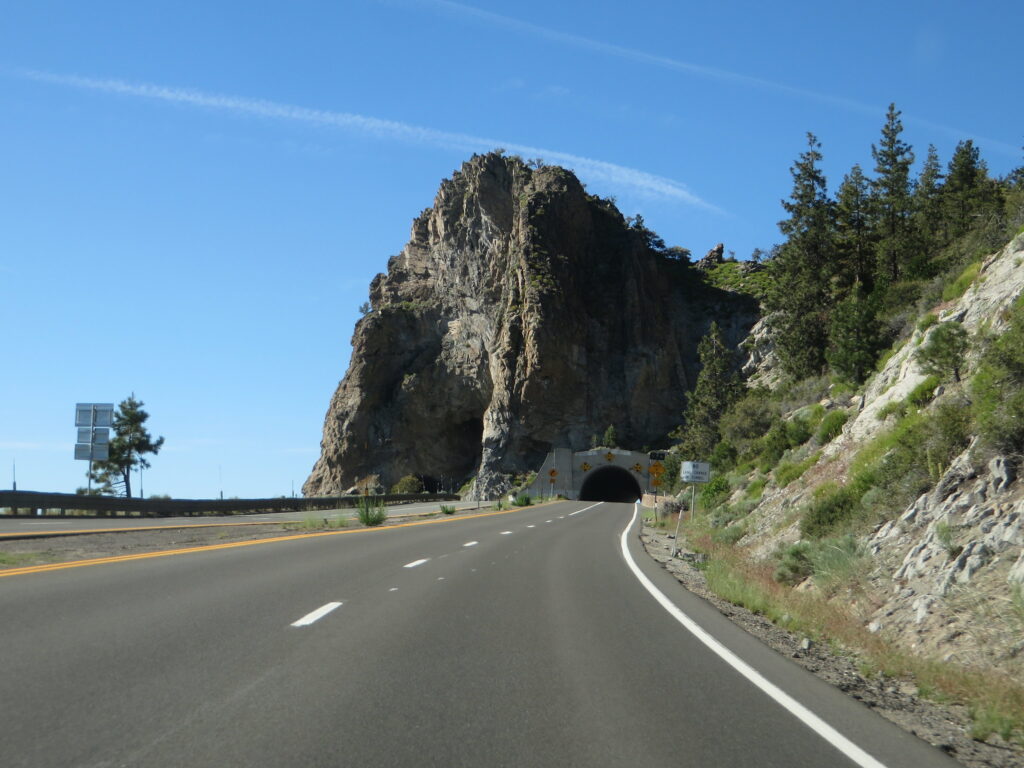
The Washoe people identify Cave Rock as “de’ek wadapush,” or Standing Grey Stone. The site is considered sacred because it is the place where a large mythical bird central to the Washoe origin stories once lived and. It is also the gathering place of “me’tsunge,” malicious water creatures that could wreak havoc or, if handled properly, give knowledge and power which can be used for medicinal purposes.1d’Azevedo, Warren, “Two Worlds of Lake Tahoe: A Report on Cave Rock,” Nevada State Museum Anthropological Papers No. 26 (October 2008). http://kaga.wsulibs.wsu.edu/ebooks/TwoWorldsLakeTahoe.pdf They continue to grant information to trained Washoe medicine men. “We’re required to say a prayer before we even mention it,” said A. Brian Wallace, former Washoe Tribal Chairman, of the importance of Cave Rock.2Roberts, David. “Whose Rock Is It Anyway?” Smithsonian 33.12 (2003): 26-28.
As a result of its spiritual importance, the Washoe have a number of taboos concerning the use of Cave Rock. The cardinal principle is that only Washoe medicine men are allowed on the formation. The power of the rock is so great an untrained visitor on the site will cause harm to both him/herself and the Washoe people.3d’Azevedo, Warren,”Two Worlds of Lake Tahoe: A Report on Cave Rock,” Nevada State Museum Anthropological Papers No. 26 (October 2008). http://kaga.wsulibs.wsu.edu/ebooks/TwoWorldsLakeTahoe.pdf The Washoe believe that more problems result from the presence of rock climbers on Cave Rock than from cars driving in the tunnels built through it. While the cars pass through quickly and absorb little power, the climbers gain much from intimate contact with the rock. Therefore, according to members of the tribe, climbers, not cars, threaten the traditional Washoe spiritual system.