
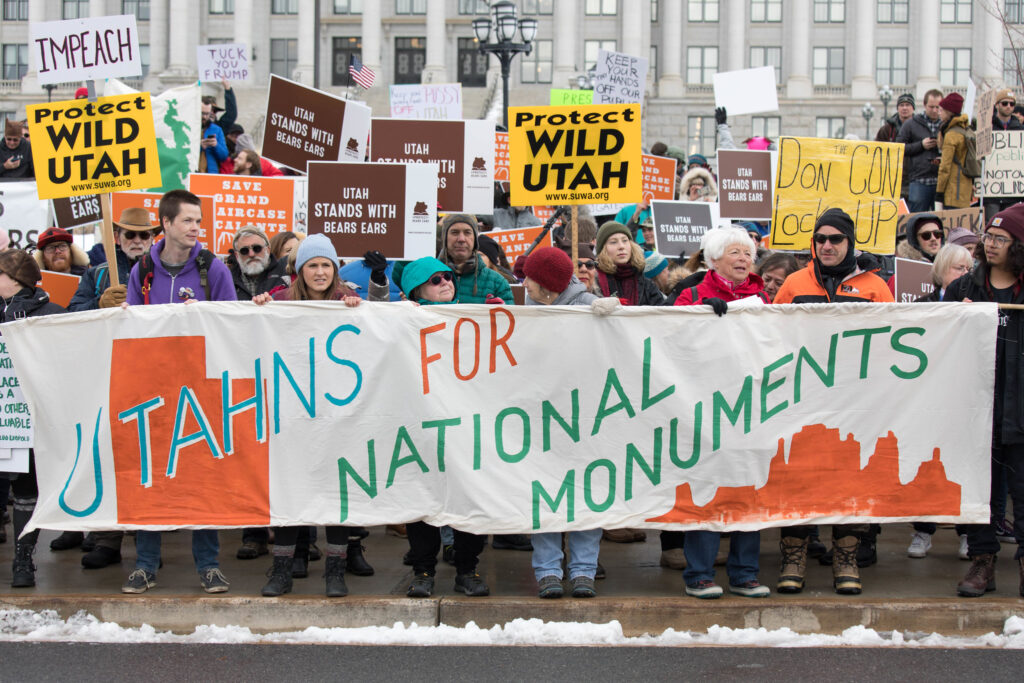
With Obama’s proclamation, Bears Ears was protected from development and secured for recreational and ceremonial purposes for the future. The document acknowledged that “the area’s human history is as vibrant and diverse as the ruggedly beautiful landscape. From the earliest occupation, native peoples left traces of their presence.”1U.S. President, Proclamation, “Establishment of the Bears Ears National Monument” (December 28, 2016). https://www.blm.gov/sites/blm.gov/files/documents/files/2016bearsears.prc_.rel_.pdf As such, attached to the monument’s creation was the establishment of a Bears Ears Commission with one representative from each of the five Native peoples from the area. It effectively gave equal voice to these peoples in making decisions about the monument along with the Bureau of Land Management, which was a groundbreaking way to create the monument, consistent with the principles of UNDRIP.
From the beginning, Obama’s opponents said that he was overstepping his executive power and seizing lands for the federal government in a way that was not authorized. In fact, presidents have been creating national monuments like Bears Ears since the American Antiquities Act of 1906 was signed into law. In 2016, it became a partisan issue of federal overreach versus protections for ecosystems and Native cultures.2Darryl Fears, “As Zinke listens in on the monumental divide at Utah’s Bears Ears, natives feel unheard.” The Washington Post, May 15, 2017. https://www.washingtonpost.com/national/health-science/as-zinke-listens-in-on-the-monumental-divide-at-utahs-bears-ears-natives-feel-unheard/2017/05/14/3243a7ec-3726-11e7-b4ee-434b6d506b37_story.html
In response, President Trump removed the Bears Ears monument as established by the Obama administration. He left two separate monuments, called Shash Jaa and Indian Creek, concentrated around the most obviously visible cave dwellings and petroglyphs. The rest will be available for industrial uses such as mining, oil drilling, and commercial development. While Trump is not the first president to try to diminish the size of a monument he is trying to revoke the protected status of Bears Ears entirely and create the smaller plots in its place, which has never been done.3“Antiquities Act Monuments List,” U.S. Department of the Interior National Park Service, last updated October 2018. https://www.nps.gov/archeology/sites/antiquities/monumentslist.htm As any member of the affected Native tribes would tell you, the sacredness is not only in one or two spots, it is spread throughout the entire landscape with its plants, animals, skies, and waters included.
Naturally, there was backlash from Native communities, followed by several other environmentalist and civil rights groups with interest in maintaining Bears Ears. There was a series of three lawsuits filed against President Trump. They later got consolidated into one case, Natural Resources Defense Council, et. al. v. Donald J. Trump, et. al., since they were all making the same basic argument that under the American Antiquities Act of 1906, the President does not have the power to undo the creation of a National Monument. They are not making the case explicitly on the grounds that Bears Ears deserves to be a monument, they are saying that Trump could not have done this himself. Instead, it needed to be an act of Congress.
“The issue here is simple: whether the President had the authority to do what he did. He clearly did not. Neither the plain text of the Antiquities Act, nor its legislative history can be reasonably construed to allow the President to do what he purported to do here. To the contrary, in revoking the original Bears Ears Monument and replacing it with two remnants, President Trump usurped power reserved only to Congress – a power that Congress has repeatedly reaffirmed and claimed for itself.”
–Native American Rights Fund Staff Attorney Natalie Landreth4“TRIBES FILE FOR SUMMARY JUDGMENT IN BEARS EARS CASE” Native American Rights Fund, January 9, 2020. narf.org/cases/bears-ears
In the motion for partial summary judgment quoted above, the plaintiffs claimed that the facts of the case (these being the historical, cultural, and environmental significance of Bears Ears) were not disputed, it was simply a matter of law and, therefore, a trial was unnecessary. Oral arguments before the U.S. District Court concluded during the summer of 2020, and the case now awaits a decision, expected to come out in the next few weeks. Advocates expect that the case will be appealed to the D.C. Circuit Court of Appeals but pledge their persistence until they win.5“Access Fund Wraps Up Arguments in Bears Ears Lawsuit, Awaits Decision.” Access Fund, July 13, 2020. https://www.accessfund.org/news-and-events/news/access-fund-wraps-up-arguments-in-bears-ears-lawsuit-awaits-decision
