
The Lakota call Bear Butte “Mato Paha”, or Bear Mountain, and believe the Butte to be the most powerful landmass in their religion. They consider Bear Butte sacred for its location near the Black Hills and due to the fact that one can find the seven sacred elements – land, air, water, rocks, animals, plants, and fire – surrounding the Butte. The Lakota believe that Bear Butte is most sacred when worshippers pray there with the Lakota Sacred White Buffalo Calf Pipe.1“White Buffalo Calf Woman (Ptecincala Ska Wakan): The Gift of the Sacred Pipe,” Keepers of the Sacred Tradition of Pipemakers, accessed July 21, 2020, https://www.pipekeepers.org/buffalo-white-calf-woman.html.
On April 4, 2006, Debra White Plume spoke to the commissioners who were listening to public input on the request for a liquor license by a biker bar to be built near Bear Butte. While speaking she attempted to confer the significance of the Mountain. She related the story of how the map of the sky that guided the spiritual life of the greater Lakota, Dakota, and Nakota Nations was given to them on the top of Bear Butte. The map particularly instructed the Sioux on how they should behave while near or on Bear Butte. The receiving of the star map is not unlike the receiving of the Ten Commandments on Mt. Sinai, an integral story to Judeo-Christian belief systems. She explained how people gather at Bear Butte at particular times of the year to consider important tribal questions and make lasting decisions for the people, as well as to gather medicine and food.2Debra White Plume, “They Don’t Want Indians Praying at Bear Butte,” Turtle Island Native Network News, April/May 2006, http://www.turtleisland.org/news/news-bearbutte.htm.
The Cheyenne call Bear Butte “Noahvose” and believe that their gods presented their mythical hero, Sweet Medicine, four sacred arrows and a medicine bundle in a cave at Bear Butte.
Wandering alone over the prairie, the boy heard a voice calling, leading him to a beautiful dark-forested land of many hills. Standing apart from the others was a single mountain shaped like a huge tipi: the sacred mountain called Bear Butte. Sweet Medicine found a secret opening which has since been closed (or perhaps is visible to him alone) and entered the mountain. It was hollow inside like a tipi, forming a sacred lodge filled with people who looked like ordinary men and women, but were really powerful spirits. “Grandson, come in, we have been expecting you, “the holy people said, and when Sweet Medicine took his seat, they began teaching him the Cheyenne way to live so that he could return to the people and give them this knowledge. First of all, the spirits gave him the sacred four arrows, saying, “This is the great gift we are handing you. With these wonderful arrows, the tribe will prosper. Two arrows are for war and two are for hunting. But there is much, much more to the four arrows. They have great powers. They contain rules by which men ought to live.”
The Life and Death of Sweet Medicine as told by the Strange Owl family3Strange Owl family, “The Life and Death of Sweet Medicine,” as recorded by Richard Erdoes on the Lame Deer Indian Reservation, Montana, 1967, http://members.tripod.com/~Glove_r/Sweet.html.
This story explains the importance of Sweet Medicine as a prophet to the Cheyenne. The fact that Sweet Medicine is said to have communed with the spirits on Bear Butte is evidence of the fact that the mountain is a place of acute religious importance to the Cheyenne. The Cheyenne and the Lakota, along with the plethora of other Native nations, hold annual sun dances, sweat lodges, and vision quests at Bear Butte, making it one of the most active Native American sacred sites in the United States.
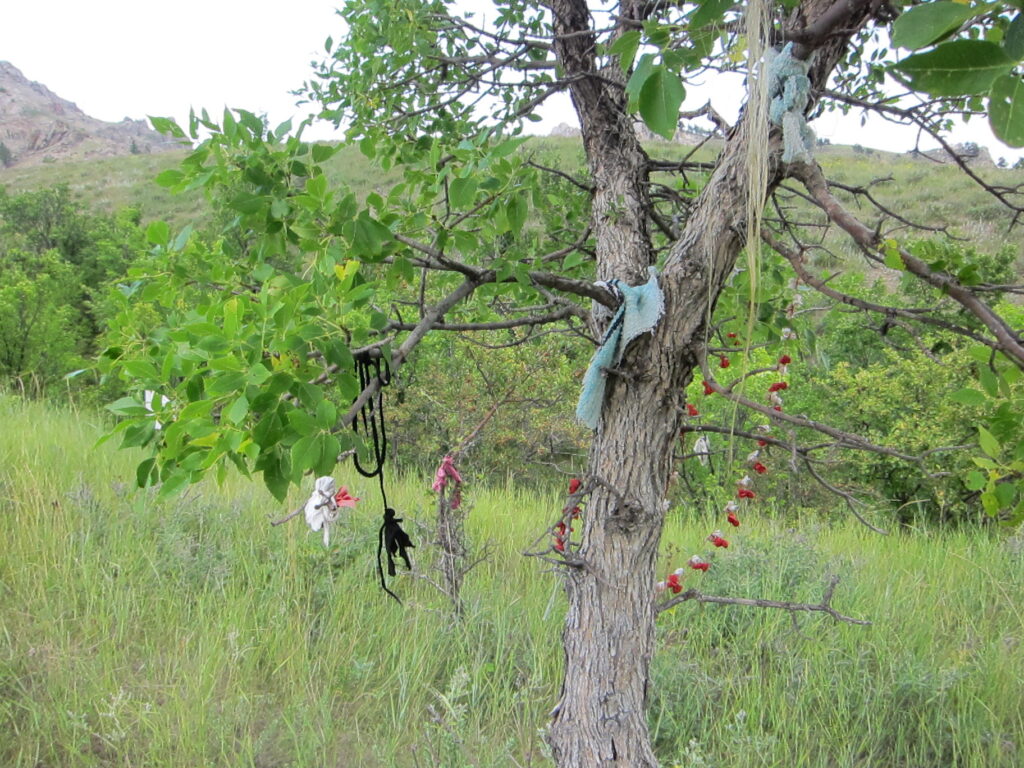
The religious magnitude of Bear Butte becomes apparent when examining its rich history. Red Cloud, Crazy Horse, and Sitting Bull all camped, prayed, and performed ceremonies at Bear Butte during their lifetimes. A council of Sioux met at Bear Butte for yearly summer conventions; in 1857, a much larger convention, including the Teton, Miniconjou, Oglala, Sans Arc, and Hunkpapa Sioux tribes convened at the mountain to discuss the invasion of the white men onto their lands. During this convention, the young Crazy Horse underwent an Inipi, or a purification ceremony, and had a great vision on the inclines of Bear Butte, which his father interpreted as meaning that Crazy Horse would one day be a great warrior. In June 1871, Crazy Horse returned to Bear Butte for a Hanblecheyapi, or a vision quest, and foresaw the upcoming Black Hills War. After Crazy Horse’s death, legend has it that his followers buried him near Bear Butte.4Bill Markley, “Bear Butte, Sacred to Cheyennes and Lakotas, Looms Near the Black Hills,” HistoryNet, June 2009, https://www.historynet.com/bear-butte-sacred-cheyennes-lakotas-looms-near-black-hills.htm.
