
Treaty History
Bear Butte is so important to the Lakota that when they met with the United States government in 1868 to discuss treaties, the Lakota demanded the control and ownership of the Black Hills, or Paha Sapa, forever. The Fort Laramie Treaty of 1868 spelled out the agreement in very clear, unmistakable language so that the Black Hills would be:
set apart for the absolute and undisturbed use and occupation of the Indians herein named…and the United States now solemnly agrees that no persons…shall ever be permitted to pass over, settle upon, or reside in the territory described in this article.
Fort Laramie Treaty of 18681“Fort Laramie Treaty,” signed April 29, 1868, http://www.pbs.org/weta/thewest/resources/archives/four/ftlaram.htm.
The federal government decided to break this treaty almost immediately after signing it. Columbus Delano, Secretary of the Interior and the man responsible for the land rights of the Sioux Nation said in 1872:
I am inclined to think that the occupation of this region of the country is not necessary to the happiness and prosperity of the Indians, and as it is supposed to be rich in minerals and lumber it is deemed important to have it freed as early as possible from Indian occupancy. I shall, therefore, not oppose any policy which looks first to a careful examination of the subject… If such an examination leads to the conclusion that country is not necessary or useful to Indians, I should then deem it advisable…to extinguish the claim of the Indians and open the territory to the occupation of the whites.
Secretary of the Interior Columbus Delano2Columbus Delano, quoted in “1874 Custer Expedition to the Black Hills,” Black Hills Visitor, last modified 2017, https://blackhillsvisitor.com/learn/1874-custer-expedition-to-the-black-hills/#google_vignette.
This attitude set the stage for Custer’s 1874 expedition into the Black Hills, searching for gold. General George Armstrong Custer violated the Fort Laramie Treaty on August 15th and camped with more than 1000 troops at the base of Bear Butte.


His expedition was meant to confirm or disprove the rumors of gold that were floating along the frontier. When he found gold, white settlers flooded illegally onto the Great Sioux Reservation. Not wanting to remove the miners and greatly desiring the Sioux land and resources, the U.S. government demanded the sale of the land to the U.S. by January 31, 1876. An army messenger delivered the demands to Crazy Horse and Black Twin, whose followers were camping at the foot of Bear Butte that winter. The government resorted to threats of withdrawing all aid (food, housing, medicine) from Lakota living on the reservations if the Black Hills were not surrendered to the government. However, by February of 1877, the United States was only able to convince ten percent of the adult male Sioux to sign an agreement that abrogated the Treaty of 1868 and took the Black Hills from the Sioux.3“Chapter Eight,” National Parks Service, 251-252, https://www.nps.gov/wica/learn/historyculture/upload/-8C-8-Chapter-Eight-Competing-Claims-Contested-Access-Pp-24.pdf.
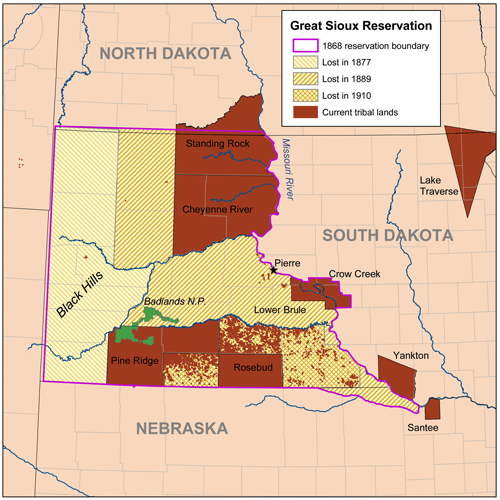
In the 1920s, the Sioux began to demand the return of the Black Hills. In the 1970s, the Sioux sued the United States government. In 1980, the Supreme Court determined the land had been unlawfully taken from the Sioux Nation and awarded the Sioux $17.5 million, the worth of the land in 1876, plus interest that accrued 5% for each year since 1877.4United States v. Sioux Nation of Indians, No. 79-639 (U.S. Supreme Court 1980). In 2011, the settlement was up to $1.3 billion.5Tom LeGro, “Why The Sioux Are Refusing $1.3 Billion,” PBS online, August 24, 2011, https://www.pbs.org/newshour/arts/north_america-july-dec11-blackhills_08-23. Justice Harry Blackmun said, “A more ripe and rank case of illegal dealings may never be found in our history.”6United States v. Sioux Nation of Indians, No. 79-639 (U.S. Supreme Court 1980). The Sioux, however, refuse to take the compensation, stating that they want rightful ownership of the Black Hills again. Even though some members of the Sioux believe that the money would benefit the Indians more than the ownership of the Black Hills, the majority still refuse to consider taking the money and instead are continuing their efforts to reclaim the land illegally taken from them.7Tom LeGro, “Why The Sioux Are Refusing $1.3 Billion,” PBS online, August 24, 2011, https://www.pbs.org/newshour/arts/north_america-july-dec11-blackhills_08-23.
Bear Butte Becomes a Park
In 1890, when the U.S. opened up the Black Hills for homesteading, Ezra Bovee homesteaded on Bear Butte. Throughout his lifetime, he cooperated with Native Americans who wished to perform sacred ceremonies on the Butte. In the mid-1950s, Ezra attempted to sell the mountain to the United States in order to preserve it as a national park; however, efforts stalled after his death, and eventually, the state bought the land and established it as a state park in 1961. In 1965, it was registered as a National Historic Landmark.8“Mato Paha: Bear Butte,” Akta Lakota Museum & Cultural Center, accessed July 22, 2020, http://aktalakota.stjo.org/site/News2?page=NewsArticle&id=8999.

Once the government established Bear Butte as a state park, a paved parking lot, visitor center, hiking trails, roads, and a campground were built at the foot of the mountain to benefit tourists. In the 1980s, Cheyenne and Lakota spiritual leaders decided to sue the South Dakota Fish and Parks Department and the state of South Dakota for the exclusive right to Bear Butte, saying that the public impeded their free exercise of religion. In 1983, in Fools Crow v. Gullet, the 8th Circuit Court of Appeals decided that the state park did not infringe upon the First Amendment rights of the Lakota and that the courts could not give the Lakota exclusive access to Bear Butte as that would violate the Establishment Clause of the Constitution.9Crow v. Gullet, 706 F.2d 856 (8th Cir. 1983).
Currently, Bear Butte State Park is making an effort to cooperate with Native American worshippers. The park service has built two hiking trails: one is for the general use of the public, while the other is exclusively for worshippers. The employees at Bear Butte also instruct visitors to respect the multi-colored prayer flags and tobacco ties left during prayers. Native Americans wishing to pray at Bear Butte do not have to pay the entrance fee. In addition, the park service is hoping to add tribal members to their staff in order to more fully educate the public on the sacred aspects of Bear Butte.10“Bear Butte State Park,” South Dakota: Game, Fish & Parks, last modified 2020, https://gfp.sd.gov/parks/detail/bear-butte-state-park/.
Sturgis Motorcycle Rally
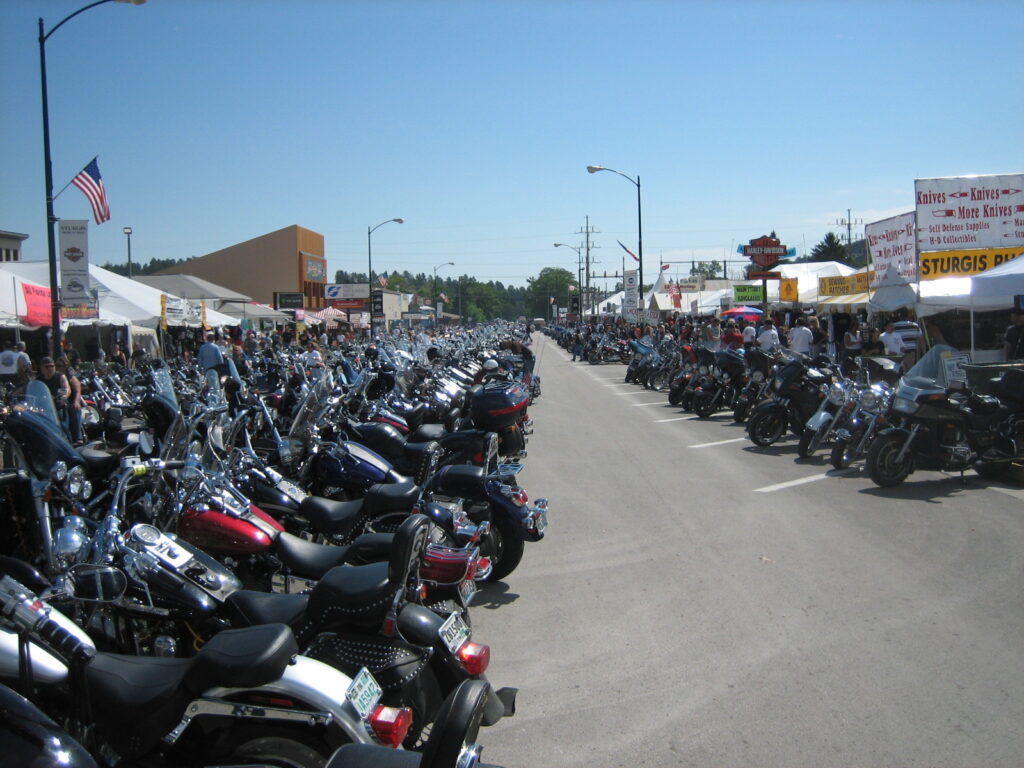
Sturgis, the closest town to Bear Butte, holds a motorcycle rally every summer. In 2004 and 2005, over 500,000 motorcyclists flooded Sturgis to attend the rally. Due to the immense popularity of the rally, the town has a high demand for entertainment events and campgrounds to house all the visitors. Two developers stepped to the forefront of this demand in the early 2000s: Gary Lippold, the owner of Glencoe CampResort, and Jay Allen, the owner of the Broken Spokes Saloon in Sturgis. These two men are mostly responsible for controversial liquor licenses, a large concert venue, and saloon in and around Sturgis. Locals opposing these developments formed a loose and unlikely coalition of Native American nations, ranchers, and Christians.11Judy Peres, “Sturgis-area tribes want buffer from bikers,” The Spokesman-Review online, August 6, 2006, https://www.spokesman.com/stories/2006/aug/06/sturgis-area-tribes-want-buffer-from-bikers/. A primary concern was noise pollution disturbing religious activity around Bear Butte. Debra White Plume, a Lakota Sioux woman from nearby Pine Ridge Indian Reservation, said in 2006:
Imagine sitting in a church or sitting in a synagogue, trying to have a … prayer service, and you have half a million bikes running by every minute of the day and night for three weeks… That’s what the Sturgis Motorcycle Rally does to this environment.
Debra White Plume12Judy Peres, “Sturgis-area tribes want buffer from bikers,” The Spokesman-Review online, August 6, 2006, https://www.spokesman.com/stories/2006/aug/06/sturgis-area-tribes-want-buffer-from-bikers/.
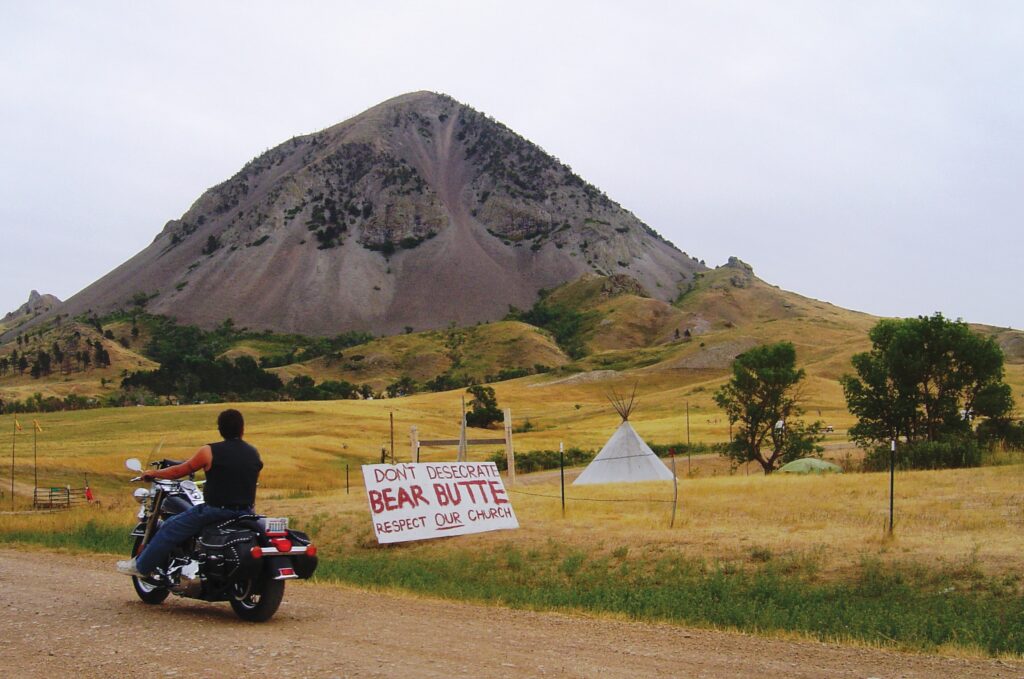
This conflict over noise disturbance and development in Sturgis has arisen multiple times over the past 20 years whenever new venues that have the potential for noise or morality disruption are proposed. Concerned tribal members and leaders participate in and organize protests around Bear Butte, carrying out their duty to protect the mountain and protect the continuation of their religious practices.13ICT editorial team, “Protestors take message to Sturgis Motorcycle Rally,” Indian Country Today online, August 16, 2016, https://indiancountrytoday.com/archive/protesters-take-message-to-sturgis-motorcycle-rally-Xwx2rBVLQEGIQRHFez6rqg. The conflict continues because the rally brings in over 500,000 bikers in just one week in August each year, greatly stimulating the local economy. Opposition to new rally-centered projects raises questions of how to sustain the Sturgis economy if development stops. Native protectors keep fighting against development to assert their treaty rights to Bear Butte, their religious freedom rights, and to establish some kind of compromise with the political leaders of Sturgis.14Gary Leventhal, “Bear Butte,” YouTube.com, December 10, 2006, https://www.youtube.com/watch?v=KiVoUv9BigQ&feature=youtu.be.
COVID-19 has resurrected concerns over the mass influx of bikers scheduled for August 7-16 2020. In 2020, the coronavirus disproportionately affects Native American populations.16Randall Akee, “How COVID-19 is impacting indigenous peoples in the U.S.,” PBS online, May 13, 2020, https://www.pbs.org/newshour/nation/how-covid-19-is-impacting-indigenous-peoples-in-the-u-s. At the 2020 motorcycle rally, there are measures in place to discourage large gatherings, including sanitation stations and no concerts,17Patrick Anderson, “Why the Sturgis Motorcycle Rally is a go despite opposition from residents,” Aberdeen News online, July 17, 2020, https://www.aberdeennews.com/covid19/why-the-sturgis-motorcycle-rally-is-a-go-despite-opposition-from-residents/article_866a44f8-c78c-11ea-9dca-2fa63f39872a.html. but only time will tell if this festival does more harm than economic good for Sturgis and local Native American nations.
