
Since 2003 there have been plans to build a massive telescope called the Thirty Meter Telescope on the peak of Mauna Kea. In 2014, a group of Kanaka Maoli people took on the role of kia’i (protectors) and physically blocked the access road that goes up the mountain to stop the groundbreaking ceremony of the telescope. The kia’i believe that such a massive scientific instrument atop their religious home would damage the natural beauty of the mountain and compromise their spiritual relationship with it. According to David Uahikeaikalei‘ohu Maile, professor of Indigenous politics at the University of Toronto, the mountain is the link between the Kanaka Maoli people and the world of sacred beings and ancestors. To destroy it, he says, would be to effectively destroy Kanaka Maoli culture and capitulate to “a settler-state illegally occupying Hawai’i.” Construction was temporarily stopped, and for the 6 years since the Native Hawaiians and TMT proponents have debated who has the right to be on Mauna Kea.
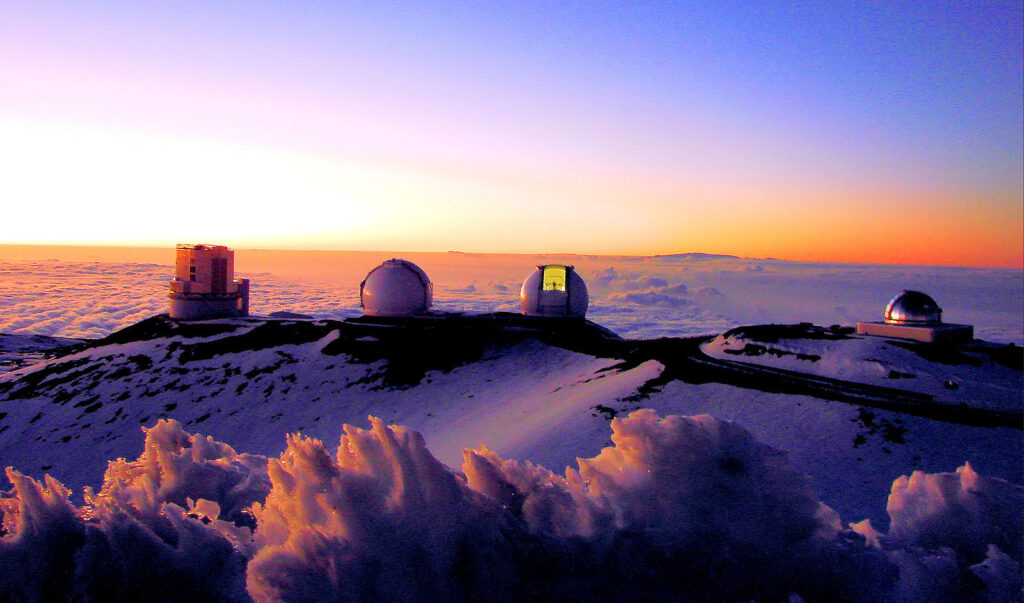
There are already thirteen observatories on Mauna Kea’s summit. A central part of the argument for building the observatory is that one more structure there should make no difference to the Kanaka Maoli when there are already so many. For the Kanaka Maoli people, however, the issue is about taking a stand to protect what is left of their sacred mountain and not allowing further damage to be done, though there already is some. They feel that the Department of Land and Natural Resources is mismanaging the mountain by using it primarily for the development of observatories and not considering the best interest of the people who have lived close to it and based their cultural identity on it for generations, or even the best interest of the greater Hawaiian population. Additionally, they claim, the DLNR and the state have flouted state laws regarding historic and environmental preservation.
The TMT group has gone to great lengths to get construction approval from various government and environmental agencies. The government of Hawaii has given the TMT a green light every step of the way, pledging its support for the project. Mauna Kea was protected under the National Historic Preservation Act but that protected status has already been waived to approve construction.
In 2018, the Hawai’i Supreme Court issued a final decision in favor of construction of the TMT. At the heart of the case is a clause in the Constitution of the state of Hawai’i that states, “the State reaffirms and shall protect all rights, customarily and traditionally exercised for subsistence, cultural and religious purposes and possessed by ahupua’a tenants who are descendants of native Hawaiians who inhabited the Hawaiian Islands prior to 1778.” Seeing as most of the demonstrators on Mauna Kea were such descendants, they appealed to Hawai’i’sSupreme Court saying that their constitutional rights to continuation of tradition would be violated if the TMT were to be placed on their sacred site. However, the court found that the exact proposed site for the TMT had no evidence that Kanaka Maoli ceremonies had ever occurred there, and, more importantly, the shrines that demonstrators put there after the initial groundbreaking date and blockade do not count as traditional.
Construction was set to restart in July of 2019, but the kia’i moved right back into the access road, where they have stood ever since. In response, police forces moved to disperse the group and clear the path for construction crews. The demonstrators gained support for their cause nationwide when videos of Kanaka Maoli elders being arrested and loaded into police vans circulated online. Many say that their commitment to protecting Mauna Kea only grew stronger in the face of such powerful opposition from the state.
“Our parents tried to fight it, we tried to fight it, and we continued to be steamrolled, so we’re not going to leave it for our children and our grandchildren to have to deal with. This is it. We’re drawing the line in the sand and we’re not allowing any more development or desecration on the top of our sacred mountain.”
Noe Noe Wong-Wilson, Native Hawaiian activist and educator in Like a Mighty Wave
As a result of their collective resistance to the industrialization of Mauna Kea, Kanaka Maoli culture has blossomed. At the site of the protests, kia’i hold “protocols” three times a day, prayerful ceremonies that deepen their connection with the mountain and with their ancestral tradition. They teach traditions like singing and hula dancing and have brought the Hawaiian language to life among younger generations. They call it the Pu’uhuluhulu University to teach the ways of their culture. In this way, civil disobedience has fueled the tradition and has become the tradition, though the Hawaiian Supreme Court did not recognize it as such.

