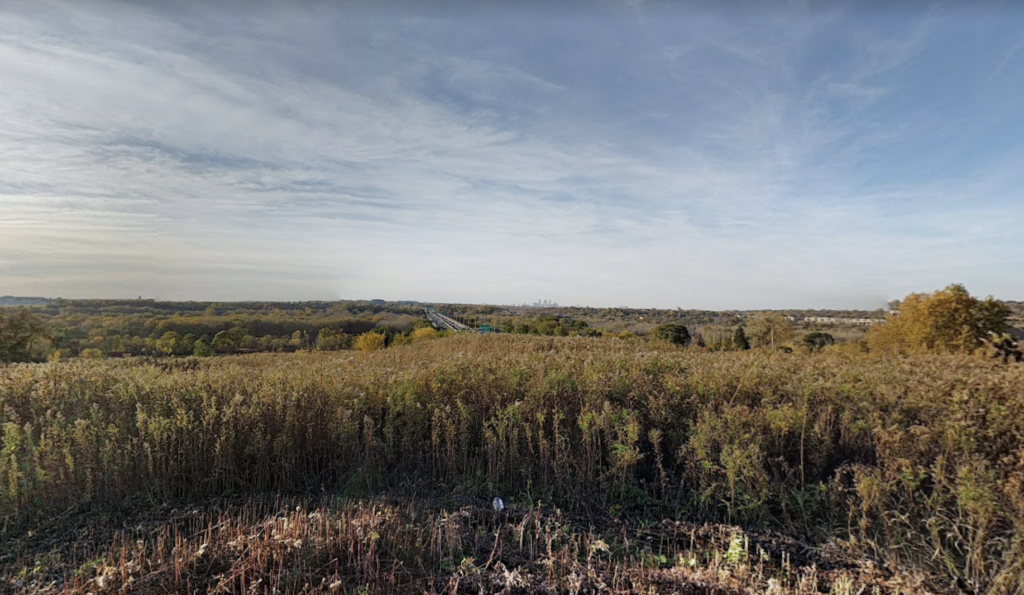
Ultimately, Minnstar Builders Inc. lost the battle to develop Oheyawahi because it would not pay for an Environmental Impact Statement. Yet someone still had to put up the money to buy the bluff from Minnstar in order to prevent eventual development. In December 2005, The Trust for Public Land, a private land conservation organization, purchased the 8.5-acre plot of land at Pilot Knob and sold it to the City of Mendota Heights.1 The Trust for Public Land. “Pilot Knob Bluff Protected (MN).” The Trust for Public Land. Last modified December 22, 2005. Accessed June 20, 2015. http://www.tpl.org/media-room/pilot-knob-bluff-protected-mn.
The Trust for Public Land acquired nearly two million dollars in funds for the land from the Dakota County Farmland and Natural Areas Program as well as a number of state grants. The other section was previously Acacia Cemetery, which the city acquired in 2007. Now the entire 27-acre site is owned and managed by the City of Mendota Heights.
Pilot Knob is protected by Mendota Heights as a Natural Resource Area as part of the city’s Parks and Open Space plan. While the site is officially protected as a Natural Resource Area, the city is mindful of its cultural importance to many indigenous peoples. In 2007, Mendota Heights contracted Great River Greening, an environmentalist non-profit organization, to manage the site. They developed a Natural Resource Management Plan outlining a strategy to not only restore native vegetation and wildlife, but to ensure access to the site for the public and Indian groups.
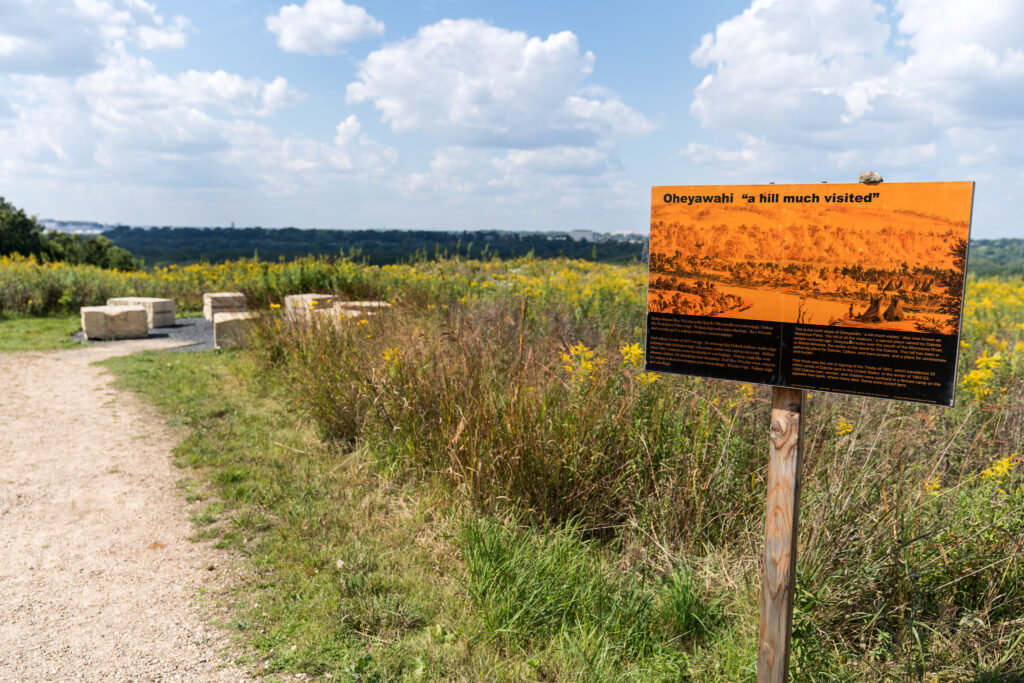
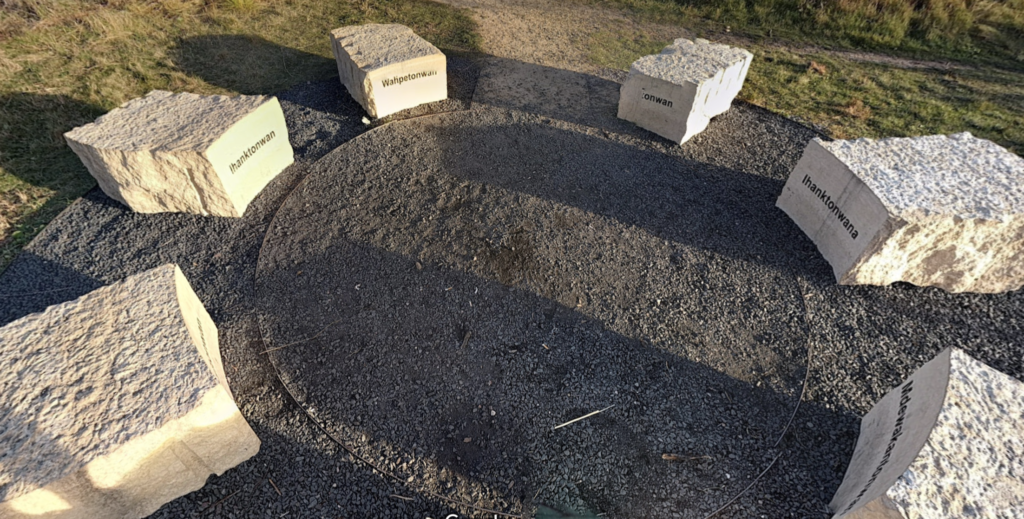
They created an open area on the bluff with capacity to accommodate large groups for ceremonies and other events. The city also accommodated Dakota interests in writing interpretive signs at visitor points on Pilot Knob, describing the cultural significance of the site to the Dakota as well as to Minnesotan history. Additionally, in 2008, the Pilot Knob Preservation Association created a “Oȟéyawahe/Pilot Knob Pocket Guide” that leads visitors through the site and explains its cultural, historical, ecological, and spiritual significance.2Pilot Knob Preservation Association, “Oȟéyawahe/Pilot Knob Pocket Guide,” 2010. http://www.pilotknobpreservation.org/47849%20Pilot%20Knob%20Guide%20new%20web%20version.pdf
In March of 2017, after 15 years of advocacy, Pilot Knob was added to the National Register of Historic Places. The reason it took so long has mostly to do with the debate between developers and preservationists over how sacred a site can really be if it has already been changed from its original state and the defenders cannot produce evidence of its value.
A Minnstar spokesman claimed the previous building of the gas station, the motel, and a few private homes, as well as the proximity of Highway 55 have damaged the integrity of Pilot Knob, rendering it no longer a “pristine historic site.” He believed that they wanted to build on the land themselves and suspected that they only wanted to oppose this development to keep the land available for their own financial gain. He also claimed that the Dakota became interested in the land only after other parties began proposing developments. He argued that if the land was actually important to them, they would have tried to buy the land while it sat on the market for twelve years.
However, National Register guidelines specify that the site need not offer physical evidence of historical importance to be eligible. Documentary and oral evidence suffice, making Oȟéyawahe eligible.
“A property may retain its traditional cultural significance even though it has been substantially modified… Cultural values are dynamic, and can sometimes accommodate a good deal of change… [T]he integrity of a possible traditional cultural property must be considered with reference to the views of traditional practitioners; if its integrity has not been lost in their eyes, it probably has sufficient integrity to justify further evaluation.”
National Register Bulletin 383National Park Service. “National Register Bulletin 38: Guidelines for Evaluating and Documenting Traditional Cultural Properties.” National Park Service. Accessed June 21, 2015. http://www.nps.gov/nr/publications/bulletins/nrb38/nrb%2038%20page%204.htm.
Therefore, despite any claims by proponents of development that Oȟéyawahe has lost its integrity because of Highway 55 nearby, other buildings on the bluff, and so forth, so long as the MMDTC considers its integrity intact, theirs is the only perspective given highest consideration by the National Register.
The efforts to restore Pilot Knob to its natural condition are consistent with the goals of the Dakota people. Like the Minnstar spokesman who equated the “integrity” of the site with previous developments near and on the bluff, sacredness is often misread as a product of stereotypical images of “untouched” or natural beauty and fails to see the true meaning of sacredness for the Dakota people.
Nevertheless, the Pilot Knob controversy has resulted in an encouraging outcome that has preserved both the site’s environment and the Dakota people’s access for religious and cultural purposes.