
Oȟéyawahe has great historical, cultural, and religious significance for both Dakota people and other Americans. The site is central to the Dakota origin story. According to the Pilot Knob Burial Register, Oȟéyawahe is a “sacred landmark” because of Unktehi’s appearance there. Unktehi is a huge being (perhaps a mammoth) with great spiritual power who created the earth in its present form. Unktehi came down the Mississippi River, damming the water behind him. Then, he turned up the Minnesota River and disappeared. Unktehi’s appearance pushed up the bluff to its current height.

Traditionally, Oȟéyawahe was used by Dakota people for Wakan (Medicine) Ceremonies (in which they would pray to Unktehi), gatherings, and other religious ceremonies. Moreover, the bluff served as a sacred burial ground for the Dakota, who often interred their dead on high ground. Archaeological evidence supports Dakota claims that they buried their dead not only on the summit but on other parts of Pilot Knob as well, rendering the entire mound a burial site.
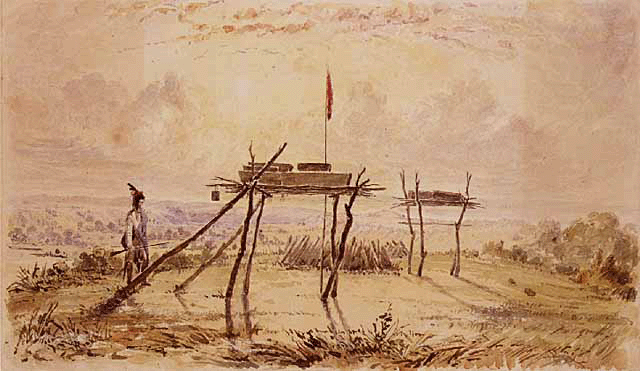
The Dakota would wrap the deceased in a blanket or, after contact with white settlers, sometimes place the deceased in a wooden coffin, and set the body on a burial scaffold or in the branches of a tree.1Pilot Knob Preservation Association. “The Oheyawahi/Pilot Knob Burial Register.” Pilot Knob/Oheyawahi. Last modified February 17, 2004. Accessed July 27, 2020. http://pilotknobpreservation.org/wp/?page_id=78. Streamers of cloth or American flags were tied to poles next to the scaffolds, and food or other offerings were placed on the scaffolds. After several days, months, or even years, what was left of the body was taken down and buried two to three feet deep in the ground. These graves were then usually marked with stones or wooden markers.
The site is also significant to many non-Native people because it was also once nominated as the site of the Minnesota territorial capitol and because it was significant to early settlers as a navigational landmark, explaining its name. It became an important part of the landscape of Fort Snelling, the first American military post in this region, regarded by some as “the area where our state was born.”2Giles, Kevin. “Land Purchase Saves a Slice of State’s Past: Pilot Knob Now has 25 Acres of Land Preserved as a Permanent Natural Resource.” Star Tribune, February 1, 2008.
