
History
In 1855, the Lummi people and many other Puget Sound-area tribes signed the Treaty of Point Elliott with the U.S. government. This treaty designated a reservation for the Lummi Nation and other reservations for the other tribes that signed.1Treaty of Point Elliott of 1855, April 11, 1859, https//:goia.wa.gov/tribal-government/treaty-point-elliott-1855. The Chief of the Lummi Tribe at that time, Chow-it-soot, clearly expressed the importance of Cherry Point and the necessity of having its land included in the treaty rights. He also stated the importance of maintaining the Tribe’s right to fish. Due to the Chief’s success in arguing these points, the Treaty included Cherry Point in the Lummi Nation’s designated reservation.2Jewell Praying Wolf James, “The Search for Integrity in the Conflict Over Cherry Point as a Coal Export Terminal,” Whatcom Watch (2013): 3, http://www.whatcomwatch.org/pdf_content/LummiInsert.pdf. Additionally, the Treaty of Point Elliott granted the Lummi Nation “the right of taking fish at usual and accustomed grounds and stations,” guaranteeing their right to fish off the shores of Cherry Point.3Treaty of Point Elliott of 1855, Article 5, April 11, 1859, https//:goia.wa.gov/tribal-government/treaty-point-elliott-1855.
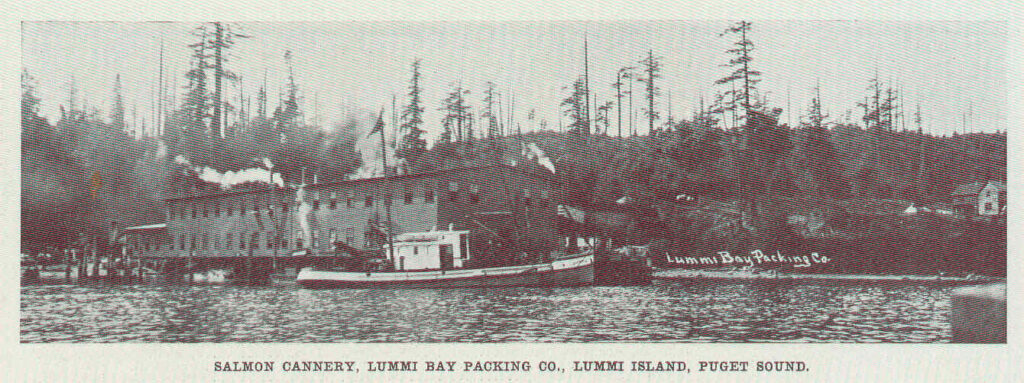
In 1872, the Lummi Nation lost their legal rights over Cherry Point when President Grant signed an Executive Order to protect non-Native squatters and alter the boundaries of Lummi land.4Jewell Praying Wolf James, “The Search for Integrity in the Conflict Over Cherry Point as a Coal Export Terminal,” Whatcom Watch (2013): 3, http://www.whatcomwatch.org/pdf_content/LummiInsert.pdf. Cherry Point land was now out of Lummi hands, but they still had a treaty right to fish off its coast – a right that was being infringed upon by Washington State authorities. This conflict between non-Native fishers, state officials, and Native fishers peaked in the 1960s and 1970s in what has been dubbed the “Fish Wars.”5Charlotte Coté, Spirits of our Whaling Ancestors: Revitalizing Makah and Nuu-chah-nulth Traditions, (Seattle: University of Washington Press, 2010), 117-18.
The 1974 court case United States v. Washington 384, commonly known as the Boldt Decision, reinstated treaty fishing rights to fourteen plaintiff tribes in western Washington State, including the Lummi. The Lummi Nation regained their treaty rights to fish in the waters along Cherry Point. The Boldt Decision also ruled that the state could not overrule treaty rights and had to stop actively infringing upon them.6United States v. State of Washington, 384 F. Supp. 312 (W.D. Wash. 1974). This ruling restored Lummi Nation’s treaty rights to fish in their “usual and accustomed grounds,” and the Lummi Nation chose this for their primary defense against the GPT construction.7Lummi Nation, Lummi Nation Atlas, (Lummi Nation: Lummi Indian Business Council, 2016), 7, https://lummi-nsn.gov/userfiles/63_2016LummiAtlas.pdf.
Community Reaction to GPT Proposal
According to PIT, Cherry Point is a prime location for a terminal. The Project Information Document, published by PIT in 2011, claims that due to the natural deep-water characteristics of the bay, Cherry Point could easily accommodate large vessels for bulk transports. Additionally, Cherry Point was zoned as Heavy Impact Industrial, meaning that it would be able to support the functions of the GPT. Other factors, such as the close proximity to a highway and pre-existing rail lines, are also included in PIT’s claims as to the conveniences of using Cherry Point for the GPT. Additionally, PIT asserts that the GPT would benefit the local economy in Northern Washington. The Document states that the terminal would create about 1,230 temporary jobs in the regional economy during its construction, and 430 permanent jobs. But other sources like Jewell James claim that permanent jobs would only total 213. The Document also claims that millions of dollars would be collected in tax revenue and millions would be generated in the local economy.8“Project Information Document: Gateway Pacific Terminal,” Pacific International Terminals, Inc, February 28, 2011.
Concerns about the Gateway Pacific Terminal existed among tribal and non-tribal communities alike. The Lummi Nation was concerned with the desecration of an ancient and sacred village site, damage to an ancient burial site, and the endangerment of the Lummi’s fishing economy and culture. This economy “generates $38 billion annually.”9Jewell Praying Wolf James, “The Search for Integrity in the Conflict Over Cherry Point as a Coal Export Terminal,” Whatcom Watch (2013): 7, http://www.whatcomwatch.org/pdf_content/LummiInsert.pdf. Members of the Lummi Nation were also concerned about the effects that increased coal shipments would have on the natural environment. Cliffort Cultee, Chairman for the Lummi Nation in 2013, states that:
We also fight to protect and preserve resources for the next seven generations. And I know coal is a step in the wrong direction. We have to stand united to oppose coal. There — we should be looking at clean energy… I’ve seen the Cape-size ships. They’re huge. They have big impacts on the environment. The coal dust. Not to say, you know, the big impact on the fishing, crabbing. Those areas out in the Cherry Point, Xwe’chi’eXen.
Cliffort Cultee, 201310“Appendix I,” EIS Gateway Pacific WA. Site has since been removed.
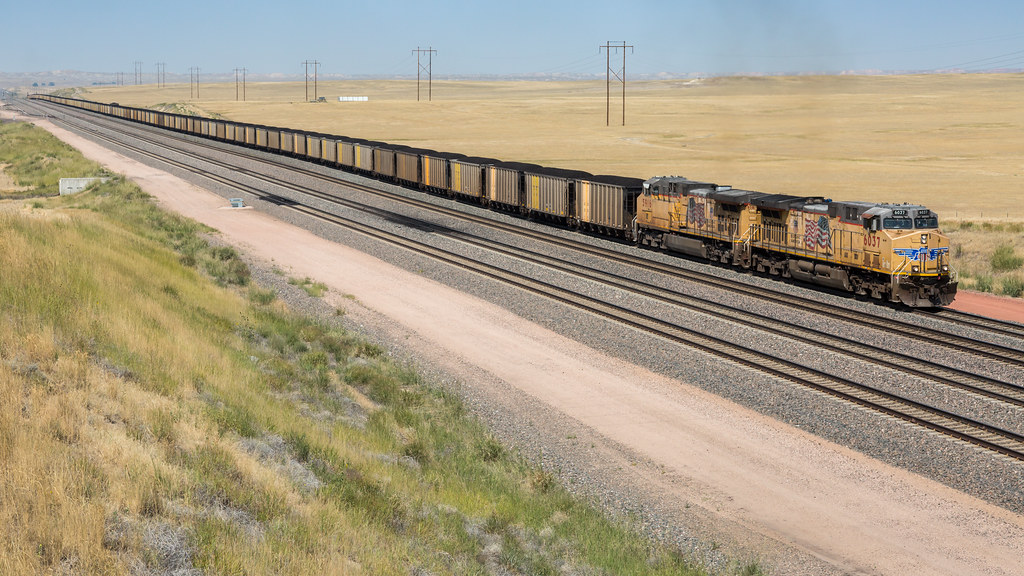
Environmentalists and non-tribal members brought concerns about environmental disturbance and pollution to the table. Residents of Bellingham and other communities near Cherry Point were “concerned about increases in train and vessel traffic, coal dust, and climate change.”11Ashley Ahearn, “Documents Reveal Coal Exporter Disturbed Native American Archaeological Site At Cherry Point,” OPB online, November 24, 2013, https://www.opb.org/news/article/documents-reveal-destruction-of-archaeological-sit/. At the time of the GPT proposal, about fifteen coal trains passed through Bellingham each day. If the GPT had been approved, up to nine more coal trains would pass through each day, resulting in one train passing through approximately every 41 minutes. Additionally, about 500 vessels would come in and out of the terminal every year.122020, Coal Train Facts, accessed July 22, 2020, https://www.coaltrainfacts.org/category/terminals/gpt/.
The transportation and burning of these 54 million tons of coal per year would emit fossil fuels that pose threats to our climate. Also, over “60,000 pounds of coal dust per train” would have been “deposited along the rail line from Powder River and at least 500 tons of coal deposits every year” at Cherry Point.14Jewell Praying Wolf James, “The Search for Integrity in the Conflict Over Cherry Point as a Coal Export Terminal,” Whatcom Watch (2013): 6, http://www.whatcomwatch.org/pdf_content/LummiInsert.pdf. Thus, the GPT would have had detrimental effects on the local and global environment, upsetting both Lummi members and the general public.
Actions Taken by PIT and Lummi Nation
In 2011, PIT carried out actions at Cherry Point which violated the National Historic Preservation Act (NHPA). PIT bulldozed an area of wetlands and drilled 37 boreholes at Cherry Point. These boreholes were used by PIT to determine whether the soil would be able to support millions of tons of coal passing over it each year.15Ashley Ahearn, “Documents Reveal Coal Exporter Disturbed Native American Archaeological Site At Cherry Point,” OPB online, November 24, 2013, https://www.opb.org/news/article/documents-reveal-destruction-of-archaeological-sit/. Because Cherry Point is in the Washington State Register of Historic Places, the bulldozing and drilling was done illegally. SSA Marine and PIT failed to consult with the Lummi Nation about the “potential archeological impacts of that unauthorized land clearing and drilling,” which was required under Section 106 of NHPA.16Sandy Robson, “Cherry Point,” Coal Stop (blog), 2013, https://coalstop.com/tag/cherry-point/page/2/. As a result, PIT had to pay a total of $4,400 in fines. Unfortunately for opponents of the GPT, this illegal construction resulted in the zoning of the land as “Heavy Industrial Impact” which proved the suitability of the land for the proposed GPT.172020, Coal Train Facts, accessed July 22, 2020, https://www.coaltrainfacts.org/category/terminals/gpt/.
In early 2013, the Army Corps of Engineers finalized the Memorandum of Agreement (MOA) which outlined a plan for the “mitigation of adverse effects to site [undisclosed]”. The document was signed by the Corps, the Washington State Department of Archeology and Historic Preservation, and PIT. However, the Lummi Nation refused to sign the MOA. By doing so, they also refused to accept the $94,000 that was offered as mitigation, which increased legal tensions between the Nation and PIT.18Ashley Ahearn, “Documents Reveal Coal Exporter Disturbed Native American Archaeological Site At Cherry Point,” OPB online, November 24, 2013, https://www.opb.org/news/article/documents-reveal-destruction-of-archaeological-sit/.
On July 30, 2013, the Lummi Indian Business Council (LIBC) sent a letter to the Army Corps of Engineers stating their opposition to the Gateway Pacific Terminal. This letter urged the Corps to immediately deny SSA Marine the permit to the GPT. In the LIBC’s letter, “the Lummi assert their quote: ‘unconditional and unequivocal’ opposition to the Gateway Pacific Terminal.” The letter states the Nation’s opposition and “reasoning behind their position, which centers on threats to treaty fishing rights and the tribe’s cultural and spiritual heritage at Cherry Point.”19Ashley Ahearn, “Documents Reveal Coal Exporter Disturbed Native American Archaeological Site At Cherry Point,” OPB online, November 24, 2013, https://www.opb.org/news/article/documents-reveal-destruction-of-archaeological-sit/.
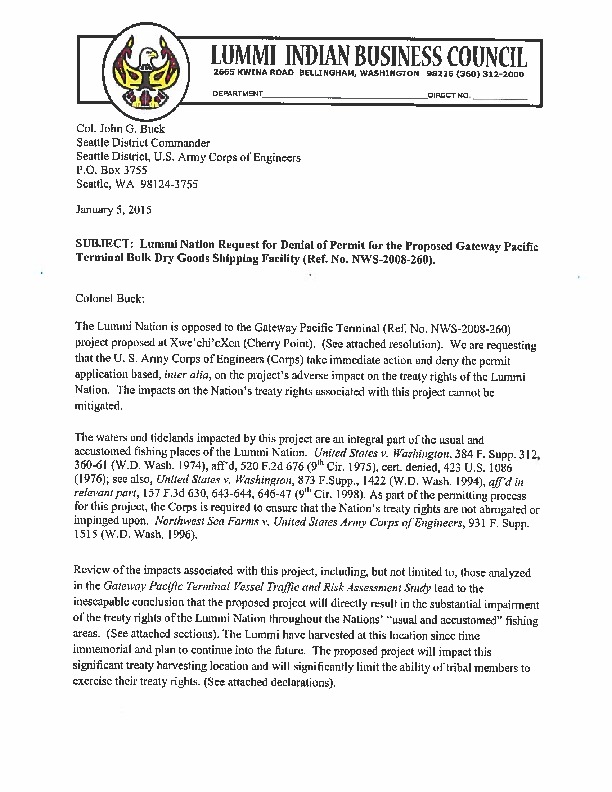
This LIBC letter stated that “the proposed project will directly result in the substantial impairment of the treaty rights of the Lummi Nation throughout the Nation’s ‘usual and accustomed’ fishing areas.” The letter also stated that the “Lummi Nation has a sacred obligation to protect Xwe’chi’eXen based on the area’s cultural and spiritual significance.” In addition, the LIBC claimed that “the proposed project location is within an especially rich and fertile marine environment that serves as important habitat for a number of forage fish, finfish, and shellfish (including several threatened and/or endangered species) that are inextricably linked to the Lummi Schelangen (‘Way of Life’).”20Tim Ballew, Lummi Nation Request for Denial of Permit for the Gateway Pacific Terminal Bulk Dry Goods Shipping Facility, (Lummi Nation: Lummi Indian Business Council), January 5, 2015. The Lummi Nation primarily employed their treaty right to fish as their legal claim in the fight against the proposed GPT.
One area that was expected to affect the GPT proposal was an Environmental Impact Statement, which would have cataloged all potential impacts to the community and laid out alternatives for PIT to take to avoid disrupting this community. A draft was started in 2014, but it was never completed. Instead, PIT asked the ACE in 2016 to stop the EIS until they had made a decision about Lummi treaty fishing rights.21“Timeline: Gateway Pacific Terminal at Cherry Point,” The Bellingham Herald online, May 10, 2016, https://www.bellinghamherald.com/news/local/article76550807.html.
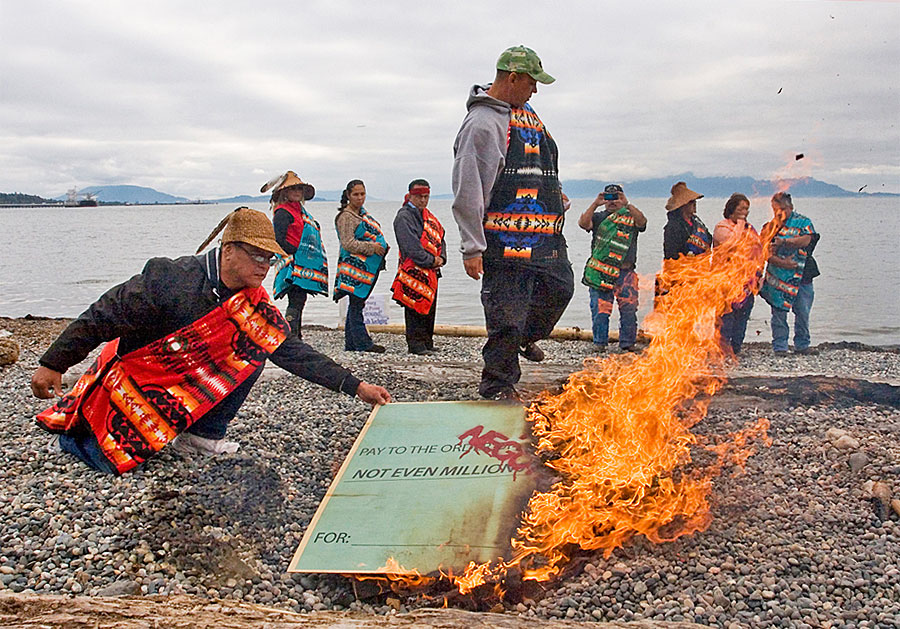
As a result of the conflict that arose over the Gateway Pacific Terminal proposal, the Lummi Nation conducted symbolic actions to demonstrate the importance of Cherry Point to their people and the global harm of burning fossil fuels. On September 21, 2012, members of the Lummi Nation gathered on the shore of Cherry Point. Members of the tribe set fire to a large, mock million dollar check to symbolize that money could not buy off their land.22Dave Gallagher, “Lummi Nation leaders come out against Gateway Pacific coal terminal project,” The Bellingham Herald online, September 21, 2012, https://www.bellinghamherald.com/news/local/article22267404.html
Then on August 17, 2014, the Lummi Nation and other Indigenous tribes from the Pacific Northwest launched the Totem Pole Journey.23“The Vision~Our Shared Responsibility: The Land, The Waters, The Peoples,” Lummi Totem Pole Background, 2014, https://docs.google.com/viewerng/viewer?url=http://nokxldakota.org/wp-content/uploads/2014/08/Lummi-Totem-Pole-Background.doc&hl=en_US. Jewell James, a Lummi member and Head Carver of the Nation, carved a 19-foot-tall totem pole that symbolized tribal unity. This was carried from site to site on this journey where tribal members congregated in different locations, uniting in a fight against Big Coal and Big Oil.24Associated Press, “Lummi Tribe taking a totem 5,000 miles to fight fossil fuels,” KOMO News online, August 28, 2016, https://komonews.com/news/local/lummi-tribe-taking-a-totem-5000-miles-to-fight-fossil-fuels. The Totem Pole Journey provided a platform for Indigenous people to stand up and speak out about issues affecting their tribes. James wrote that the Totem Pole Journey’s explicit goal was “To empower communities, networks and alliances, inform the general public, and bring a new level of understanding and engagement to successfully oppose the proposed shipment of fossil fuels across western Canada and the western United States.”25“The Vision~Our Shared Responsibility: The Land, The Waters, The Peoples,” Lummi Totem Pole Background, 2014, https://docs.google.com/viewerng/viewer?url=http://nokxldakota.org/wp-content/uploads/2014/08/Lummi-Totem-Pole-Background.doc&hl=en_US.
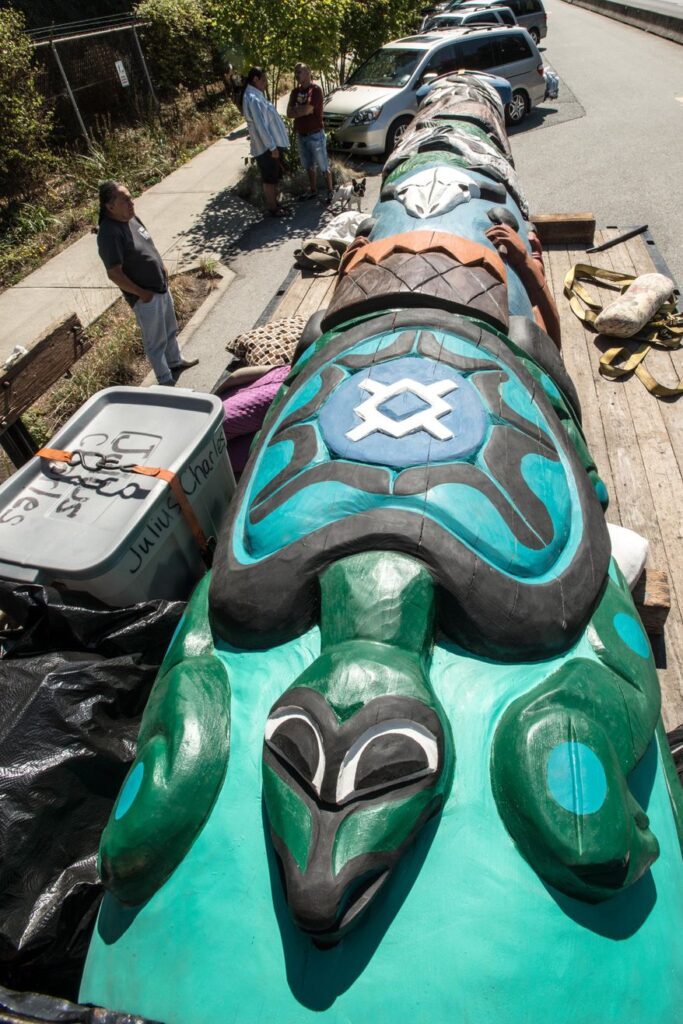
Sustained action and local support for the Lummi Nation’s cause kept their fight in the local media during the five years it took for the Army Corps of Engineers to decide the fate of the GPT proposal.
