Medicine Wheel has historically been an important place for Wyoming residents, with local Native and non-native residents often leading efforts to protect the site. The first attempt came in 1915 when residents sought to classify the site as a national monument under Section 2 of the 1906 American Antiquities Act, possibly out of a desire for tourism and thus stimulus for the local economy.1Admin, “Ancient America: The Bighorn Medicine Wheel,” Native American Net Roots, September 13, 2010, http://nativeamericannetroots.net/diary/676. This classification failed and the site remained unprotected until 1970 when it was designated a National Historic Landmark.2Fred Chapman, “Medicine Wheel/Medicine Mountain: Celebrated and Controversial Landmark,” WyoHistory.org, April 10, 2019, https://www.wyohistory.org/encyclopedia/medicine-wheel. In 1991, the U.S. Forest Service initiated a draft Environmental Impact Statement in the hopes of adding an expanded parking area and providing unrestricted public access even during Native ceremonies.3United States Department of Agriculture, Forest Service, Bighorn National Forest, Medicine Wheel National Historic Landmark: Draft Environmental Impact Statement, (Lovell, Wyoming, 1991), https://babel.hathitrust.org/cgi/pt?id=umn.31951d01944710h&view=1up&seq=4. This measure was fought by local communities and eventually, the Forest Service reconsidered the plan due to public pressure.
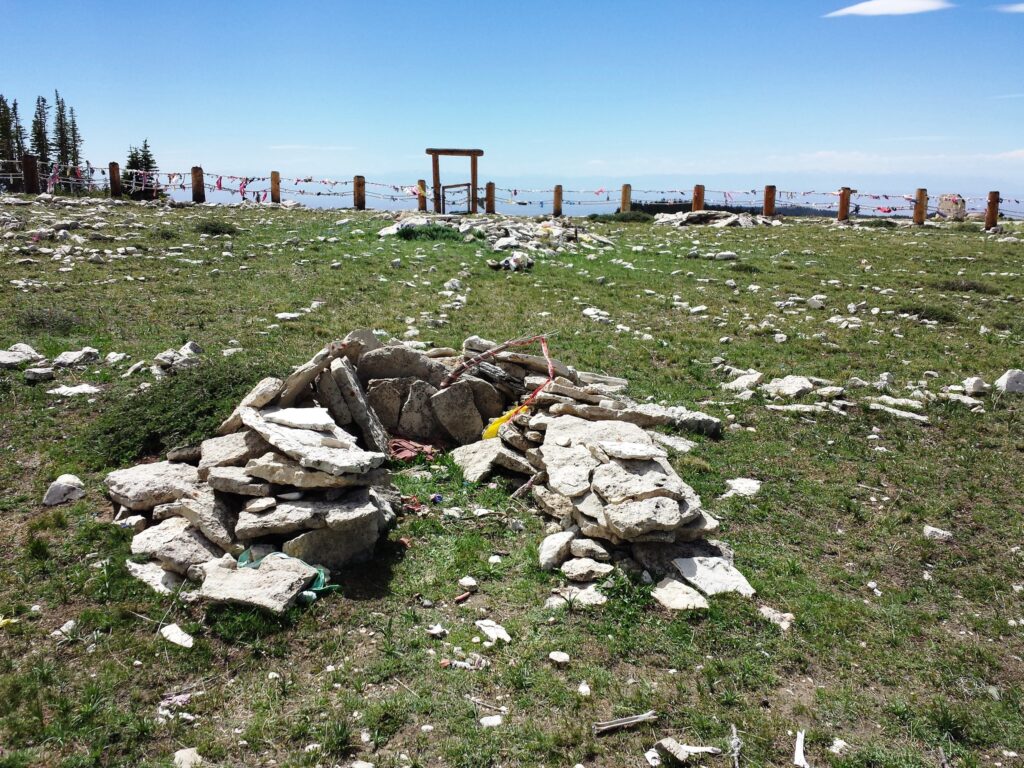
By 1993, Medicine Wheel was seeing so many tourists over the brief summers when it was not inaccessible because of snow that the alpine vegetation around the wheel had almost disappeared and paths had turned to rutted trails. Non-native visitors “attached used cigarette lighters, fish hooks, belt buckles, condoms, tampons, and other inappropriate items to the fence” possibly in emulation or mockery of the prayer flags and other religious offerings left by Native Americans.4Fred Chapman, “The Bighorn Medicine Wheel 1988-1999,” CRM, no.3 (1999): 8, https://sacredland.org/wp-content/uploads/2017/07/Bighorn_Medicine_Wheel.pdf. This led to the publication of a Historic Preservation Plan that designated 23,000 acres of Forest Service land to be consulted upon with the goal of facilitating Native American traditional uses as traditional cultural property. In 2011, the actual Landmark borders were enlarged from 110 acres to 4,080 acres in response to ethnographic information on the importance of the area surrounding the medicine wheel to local Native American nations.5Fred Chapman, “Medicine Wheel/Medicine Mountain: Celebrated and Controversial Landmark,” WyoHistory.org, April 10, 2019, https://www.wyohistory.org/encyclopedia/medicine-wheel.
The expansive territory surrounding Medicine Wheel and encompassing the Bighorn National Forest has often invited outside influence from corporations and businesses looking to profit off of the resources there. The most significant example of this is Wyoming Sawmills Inc. who sued the U.S. Forest Service in order to gain access to protected wooded areas. In Wyoming Sawmills Inc. v. U.S. Forest Service, the corporation claimed the Forest Service was causing injury to the company in order to promote Native American religions. The Forest Service claimed they were not promoting these religions, but rather only removing the unreasonable burdens necessary to practice those religions.6Wyoming Sawmills, Inc. v. US Forest Service, 179 F. Supp 2d 1279 (D. Wyo. 2001).
Though the territory around Medicine Wheel may not appear to be religiously significant to those who pray at the Wheel, the Historic Preservation Plan of 1996 is in place – among other reasons – to ensure that nearby land uses do not conflict with the aesthetic features of Medicine Wheel like quiet atmosphere and beautiful views.