
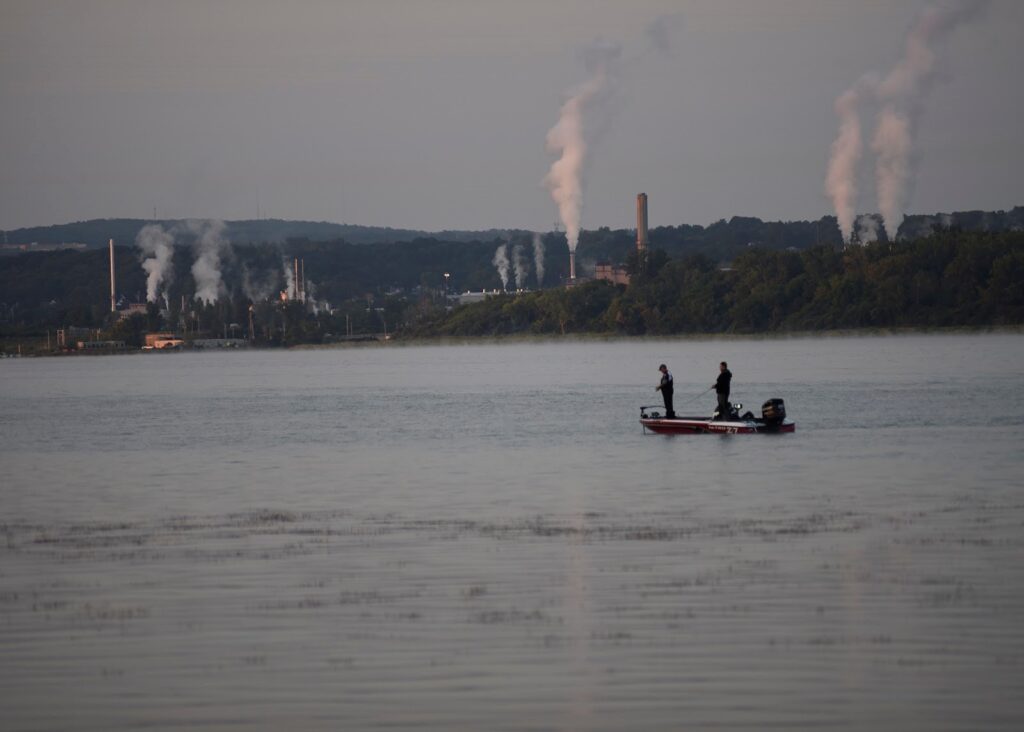
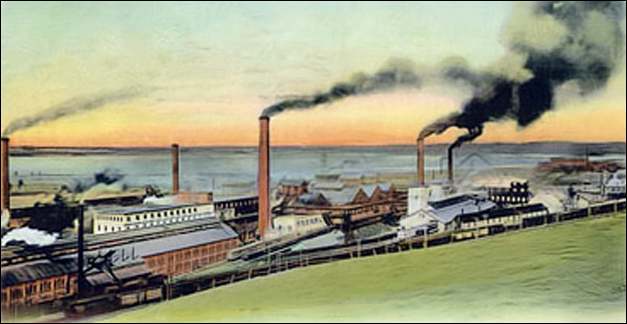
Onondaga Lake has often been called the “most polluted lake in America” despite its status as the most sacred lake to the Haudenosaunee. By World War II, the lake had become a dumping ground for municipal sewage and industrial waste from a number of companies. City sewage contamination brought about elevated levels of phosphorus, ammonia and nitrites, and of bacteria and other harmful microorganisms.1Department of Environmental Conservation, “Onondaga Lake,” DEC New York State, accessed July 28, 2020, https://www.dec.ny.gov/lands/72771.html. Meanwhile, nearby mining, coal burning, and soda ash companies introduced alarming amounts of mercury and salt waste into the lake.2David Fischer, “From Tully Valley to Onondaga Lake,” Sierra Club: Atlantic Chapter, accessed July 28, 2020, https://www.sierraclub.org/atlantic/iroquois/tully-valley-onondaga-lake. These wastes have elevated the lake’s salinity up to 10 times that of neighboring lakes, resulting in reduced oxygen levels and diminished animal diversity.3“Salinity,” OnLake Partners, accessed July 28, 2020, http://www.onlakepartners.org/p12036.html. Further, mining activity and industrial waste brought about excessive sedimentation––creating infamous “mudboils” which spread 30 tons of silt per day to neighboring Onondaga Creek. Due to this excessive pollution, officials banned swimming in the lake by 1940 and prohibited fishing in 1970, and in 2009 non-profit Onondaga Lake Partnership declared seven million cubic yards of sediment at the bottom of the lake to be contaminated with mercury.4Department of Environmental Conservation, “Onondaga Lake,” DEC New York State, accessed July 28, 2020, https://www.dec.ny.gov/lands/72771.html.
In 1997 and 1998, the Oneida Nation purchased land on the open market. They were required to pay taxes on the land, even though it once belonged to their original reservation. The Oneida Nation sued the city of Sherrill for “equitable relief from taxing tribal lands.5City of Sherrill v. Oneida Indian Nation of N.Y., 544 U.S. 197 (2005). On March 28, 2005, the Supreme Court ruled against the Oneida. First, the court found that the repurchase of tribal lands does not reinstate the land’s tribal sovereignty. Secondly, the court instituted the legal concept of laches, stating that the Oneida waited too long to bring the claim to court.
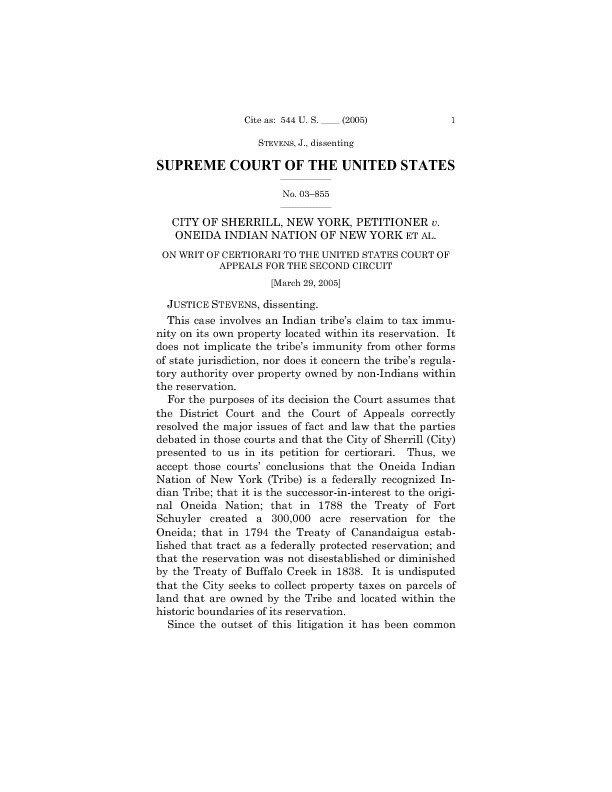
On March 11, 2005, Onondaga Nation filed a case against the State of New York, and four main polluters of Onondaga Lake: Cranesville Block, Hanson Aggregate, Honeywell, and Trigen Energy, for the illegal purchase and pollution of Haudenosaunee lands. Yet, just three weeks later, on March 28, the Supreme Court dismissed the case after deciding Sherrill v. Oneida. The Onondaga never even had a chance to present their case to the court. In October 2012, the Onondaga Nation made an argument to the appellate court to reverse the dismissal. However, they were not able to sway the judges, and the 2005 dismissal stood. On December 19, 2012, the full thirteen-judge appellate court denied the Onondaga Nation’s request to rehear the October denial.6City of Sherrill v. Oneida Indian Nation of N.Y., 544 U.S. 197 (2005).
Finally, the Onondaga filed for a writ of certiorari with the Supreme Court “seeking review of the dismissal and its affirmance.”8Onondaga Nation, “Onondaga Nation Files Second Historic Land Rights Case,” Onondaga Nation, April 15, 2014, https://www.onondaganation.org/news/2014/onondaga-nation-files-second-historic-land-rights-case/. On October 15, 2013, the Supreme Court denied the petition, leaving the Onondaga Nation with no further options for judicial action in domestic courts. On April 15, 2014, the Onondaga Nation filed a petition in a World Court against the United States with the Inter-American Commission on Human Rights (IACHR).9Onondaga Nation, “Onondaga Nation Files Second Historic Land Rights Case,” Onondaga Nation, April 15, 2014, https://www.onondaganation.org/news/2014/onondaga-nation-files-second-historic-land-rights-case/.
