
Disagreement over regulation rights
It was not until 1980 that the Penobscot Indian Nation’s territory was allotted by the state of Maine. The Maine Indian Claims Settlement Act (MICSA) of 1980 confirmed that their reservation consisted of Indian Island, also known as Old Town Island. The Nation received $81.5 million in exchange (or about $235 million in 2014) and some additional land parcels as compensation for the loss of their ancestral homeland. The MICSA allowed the Penobscots to adapt their traditional diet to the reservation, permitting hunting and fishing on their reserved lands. The Penobscot Indian Nation agreed to this settlement because it did not detach them from the resources and spiritual significance of the river.
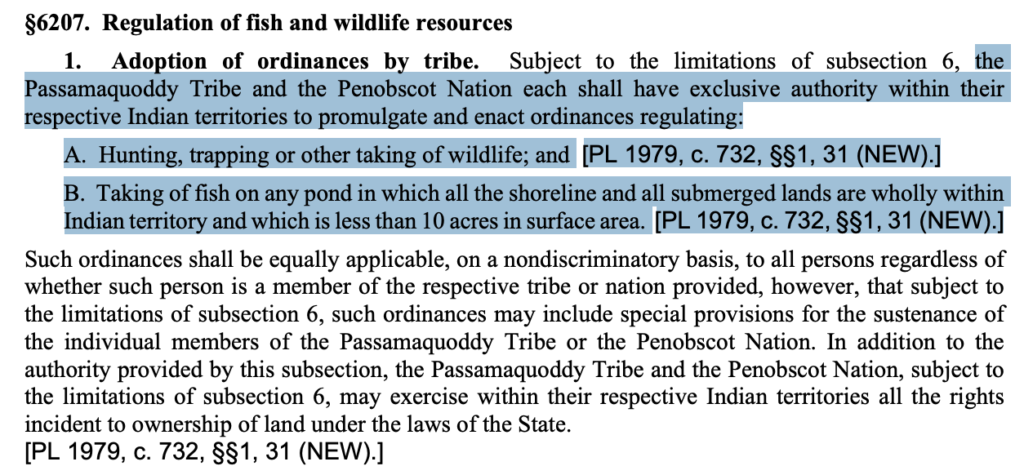
Since 1980, there have been several instances in which Penobscot tribal members confronted statesmen to assert their jurisdiction over the river. To respond to these confrontations, in August 2012 Maine’s State Attorney General William J. Schneider wrote a letter to Penobscot Tribe officials about sovereignty over the river. Schneider contended that the PIN could only regulate the islands themselves, not the river itself nor the adjacent areas:
“For the purposes of your inquiry, which involves activities occurring on the main stem of the River, this means the Penobscot has authority to regulate hunting and fishing on those islands included in its Reservation… However, the River itself is not part of the Penobscot Nation’s Reservation, and therefore is not subject to its regulatory authority or proprietary control”
Maine Attorney General William J. Schneider, in a 2012 letter to PIN leadership
In disagreement, Penobscot tribal officials said that non-tribal members, including state employees, should receive permits from the Nation to fish and boat on the river. The “main stem”of the river, addressed in Schneider’s letter, contains many islands owned by the Nation. In order to fish and hunt for food in line with their ancestral culture, the Nation needs to have authority over the water surrounding their land. According to Bennett Katz, the chairman of the Maine Tribal-State Commission in 1995, “the Penobscots never would have agreed to the Settlement [MICSA] had it been understood that their fishing rights extended only to the tops of their islands.”
To settle the disagreement, the Nation filed suit against Schneider, Mills, and other government officials on August 20, 2012. In Penobscot Nation v. Mills, the State of Maine responded that under the Settlement Act (MICSA), the state has authority to regulate hunting by non-tribal members on the main stem. The State claimed to not have given the Nation any authority in MICSA, only jurisdiction over sustenance fishing by its members within the boundaries of their reservation. The Penobscots asserted that according to the 1987 amendment to the Clean Water Act, the PIN should be able to regulate those upstream on the Penobscot River. The amendment declared that Indian tribes be treated as states, meaning that they could dictate the water quality standards of the water found on their reservation by regulating the people who impact the water upstream. The controversy expands beyond the regulation rights; the issue also encompasses the water quality of the Penobscot River.
Battle for water quality
Since the industrialization of the Penobscot River, fifteen hydroelectric dams have been built in the watershed. The Howland Dam, Veazie Dam, and Great Works Dam, found on the main stem, largely affect the water quality of the river. Additionally, many mills and residential areas established alongside the river have discarded waste into the river that has caused significant chemical changes in the water. For example, in the summer of 2007, the Katahdin Paper Mill discharged excessive phosphorus into the Penobscot River, causing an algal bloom and increased cyanobacteria 50 miles downstream Indian Island (Tribal Profile EPA). As a result, the Penobscot Indian Nation and the public were warned not to consume the fish in the river.
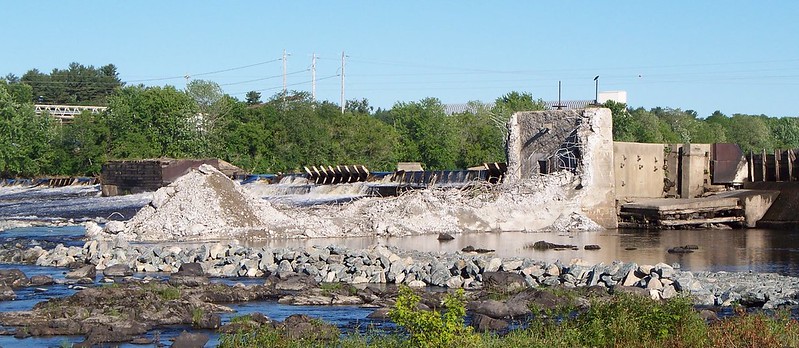
Between 2010 and the present, the Penobscot River Restoration Trust has worked to remove the dams that have caused the accumulation of pollutants and have disrupted the natural migration of many fish species. In 2013, the Great Works Dam was removed. Though this significantly improved the water flow, many species were still obstructed and harmed. The Northeast Fisheries Science Center (NEFSC) conducted the 2013 Dam Impact Analysis Model for Atlantic Salmon. The report stated the remaining dams on the main stem of the Penobscot River were detrimental to fish populations, particularly the Atlantic salmon. Though the Nation once collected great amounts of salmon for sustenance, they instated fishing limits to protect the reduced population of salmon.
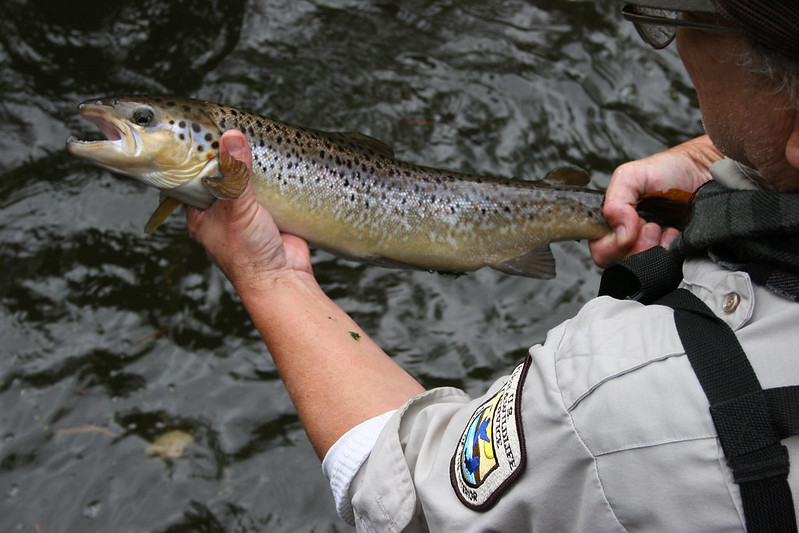
Additionally, these Atlantic Salmon and many other species in the river were found to have harmfully high levels of mercury. In 2014, the Agency for Toxic Substances and Disease Registry (ATSDR) found harmful levels of mercury and dioxin in the fish and other species in the region. The report strongly advised pregnant women and children to avoid consuming the fish of the Penobscot River. The Penobscot Indians could not connect with their culture without harming their health.
In 2014, PIN released the Penobscot Nation Water Quality Standards. The document specifies the maximum chemical concentrations for each pollutant that would keep the river water clean enough to use.
The Standards specify the designated uses of each section of the river, the species to be protected, and those that can regulate the area. As these standards rise, they become a bigger threat to industrial companies that dispose of their waste into the river. Many have resisted these changes. However, some corporations, conservationists, and the Penobscot Indian Nation have banded together to restore the river.
