
Amidst the beauty of the landscape of the Cave Hills, there is a startling relic of the Atomic Age: The Riley Pass Uranium Mine, and other pit mines. There are 89 mines in the Sioux Ranger District of the Custer National Forest, but the Riley Pass Mine Area, which includes the 13 individual mine sites located throughout the North Cave Hills, contains the most toxic and most accessible of the mines on National Forest land in Harding County. The company that mined at Riley Pass still existed and helped somewhat in reclamation until 2007, which cannot be said for many of the other “mom and pop” operations that worked the Sioux Ranger District in the late 1950’s and early 1960’s.
No uranium has been mined since 1964, but most mines were never fully reclaimed and erosion has brought toxic and radioactive piles of slag, the waste product that is left after desirable metals are extracted from the raw ore, down from the mine sites into the draws and creeks. The toxic tailings from the mines bring arsenic, molybdenum, thorium, radium 226, total uranium, uranium 235, and heavy metals with them down the creeks. During the rush to procure uranium for nuclear weapons and then nuclear power, no requirements of reclamation were placed on the mine companies who were mining public land. The Riley Pass Mine Area is so toxic that a sign erected in 2002 warned visitors not to spend more than 24 hours in a twelve month period there, but even that sign has since been torn down by vandals.
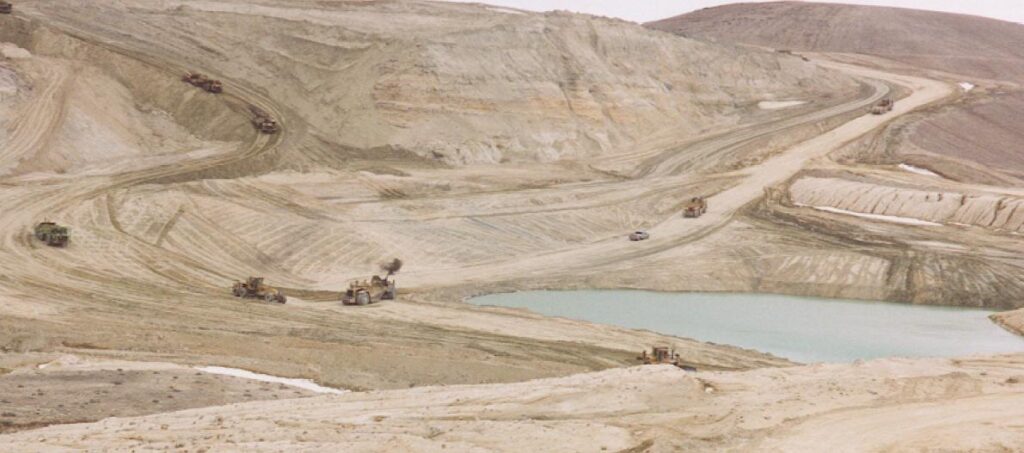
In the past two decades, people have become more and more vocal in asking why these mines have been left largely unreclaimed for over forty years. The simplest answer is that the Cave Hills are in rural Harding County, South Dakota. The interested parties are a limited contingent: Harding County residents, Plains Indian Tribes, and the deer hunters that flock to the Hills for its renowned deer hunting. Moreover, with the Forest Service lacking much necessary funding and companies not being required by law to reclaim the mines, a sort of vacuum of responsibility has surrounded the abandoned mines. However, things have been changing, even though it is 50 years too late. People have been talking about the warning sign that was erected at Riley Pass, and have started to talk about cancer in humans and diseases in the cattle that graze the hills.
The types of cancers that appear in Harding County are alarming: eleven cases of rare brain tumors have been diagnosed in Harding County in the past decade. A letter from South Dakota Department of Health officials stated that pituitary tumors occur in one in 10,000 people at autopsy, and of the 1,218 people in Harding County, 4 have pituitary cancers.
In addition to those facts, a Forest Service risk assessment written in 2006 found unacceptably high carcinogenic risks for the cattle ranchers and hunters who frequent the Riley Pass area, meaning that their risk was above the level the EPA deems a “concern.” These risk assessments were based on the calculations that cattle ranchers spend 150 to 210 days a year in the area, and hunters spend 4 hours a day, 32 days a year near Riley Pass.

In addition to human cancers, the rock where uranium was mined is eroding down the sides of the hills where cattle graze and their owners live. The eroded substances are so toxic that the mining sites remain mostly unvegetated even 40 plus years after they were abandoned. This makes the hills even more susceptible to erosion, so the toxins travel even faster.
As well as tailings traveling down the draws, the Cave Hills are near headwaters of the South Grand River, which drains into the Shadehill Reservoir before continuing on to the Missouri River. Sediments that become suspended in creeks coming out of the Cave Hills could be continuing down the Grand River to the Shadehill Reservoir, a popular sport fishery, and being deposited in the soils there or even continuing downstream to the Standing Rock Indian Reservation, where three villages still use the Grand River as drinking water, and another has during the use of the mine.
The uranium mines not only threaten the physical health of the residents of Harding County and visitors to the Cave Hills, but also endanger the spiritual well being of the Plains Indians who wish to continue to worship there as they and their ancestors have for generations. According to the 2006 risk assessment report, Native American worshippers in the area spend 25 hours per year in the Riley Pass area and have a carcinogenic risk within the range that the EPA deems a “concern.”
It is important to note what draws each of these groups of people to the area and why they are subjected to cancer-causing toxins. A rancher’s profession forces him to work in the area, a hunter’s pastime places him in the area, but a Lakota, Hidatsa, or Mandan person is in the area to practice their religion. In order for these individuals to experience and revere the sacredness of the Cave Hills, a place connected with the yearly rebirth of the bison, the people must be willing to subject themselves to cancer-causing toxins.
In truth, there is no such thing as “safe” levels of radiation, as the guidelines indicate, because because any exposure to radiation heightens an individual’s risk of cancers and inheritable genetic defects. However, the likelihood is simply lower when less time is spent in contact with radiation.
“Does this mean that the cattle, buffalo, and other wild game that eat the dust covered grass and drink the water will also be more likely to be radioactive? Or will they carry cancerous tumors that we ingest with each meal? Are the deer and antelope that travel throughout the region, down to the Black Hills, and across the Wyoming plains also radioactive? What about the birds, butterflies, and other winged insects that migrate through this area? Do they know how to read signs that say, ‘Radioactive material. No camping. Do not be in this area more than 20 hours per year’?”
Charmaine White Face, a member of the Oglala Sioux Tribe and activist for cleaning up mining sites. speaks often about the radioactive dusts and water from the abandoned mines.
In a 2015 newsletter, Defenders of the Black Hills shared that they had been going to the Riley Pass site for over 10 years, praying for cleanup and giving thanks to the Creator for answered prayers. They understood the dangers of the area: they asked for no young people to attend, and that those who did choose to go wear protective masks for dirt. Though the Cave Hills continue to be a sacred place for the native peoples of the plains, they remain a major safety concern for visitors.


