
Tradition Interrupted by Commercial Whaling
The Makah had been whaling for 2,000 years when, in the early 1900s, the they gradually stopped whaling.1“The Makah Whaling Tradition,” Makah Tribal Info, Makah Nation, accessed July 29, 2020, https://makah.com/makah-tribal-info/whaling/.
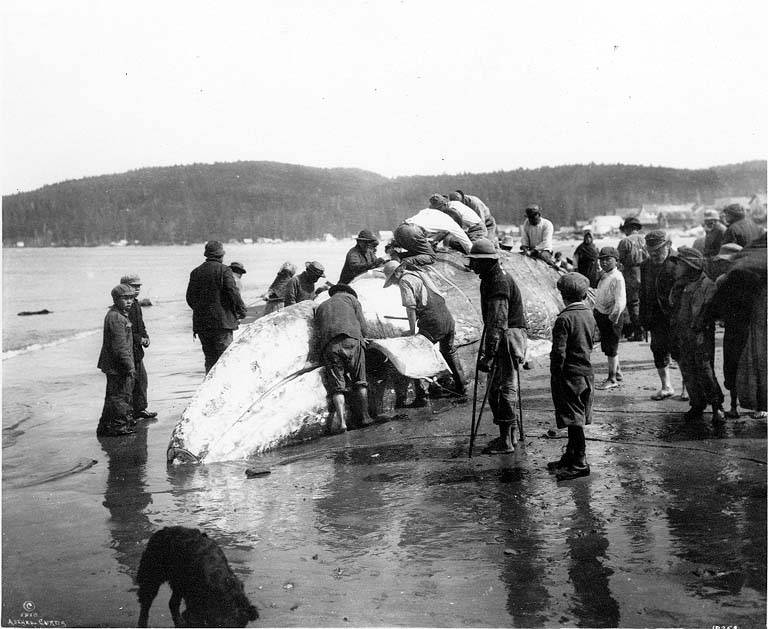
There are many explanations for this, including increasing poverty and a subsequent focus on physical survival and thus decreasing interest in time and energy-consuming whale hunts, the frequent and often unlawful discouragement by the U.S. government, and the rapid decline in whale populations in the Neah Bay area owing to American, European, and Japanese commercial whaling.2Charlotte Coté, Spirits of our Whaling Ancestors: Revitalizing Makah and Nuu-chah-nulth Traditions, (Seattle: University of Washington Press, 2010), 63-66. The population loss led the U.S. to help establish the IWC (International Whaling Commission)3International Whaling Commission, accessed July 31, 2020, https://iwc.int/home. in 1946 to regulate global commercial whaling and to put the grey whale on the Endangered Species List in 1973. The IWC also issued a moratorium on commercial whaling in the mid-1980s.4NOAA Fisheries, “Gray Whale,” NOAA Fisheries, accessed July 31, 2020, https://www.fisheries.noaa.gov/species/gray-whale. The Makah did not hunt while the grey whale was classified this way, despite their theoretical legal ability to do so.5United States Fish and Wildlife Services, Secretarial Order #3206: American Indian Tribal Rights, Federal-Tribal Trust Responsibilities, and the Endangered Species Act, June 5, 1997, https://www.fws.gov/leavenworthfisheriescomplex/secretarial_order.pdf.
1999 Makah Whale Hunt
Following a healthy recovery of the grey whale population to nearly 30,000, the grey whale was removed from the Endangered Species list in 1994. The Makah tribe notified government authorities of their interest and intention in resuming traditional whale hunts in May 1995.6Charlotte Coté, Spirits of our Whaling Ancestors: Revitalizing Makah and Nuu-chah-nulth Traditions, (Seattle: University of Washington Press, 2010), 130-31.
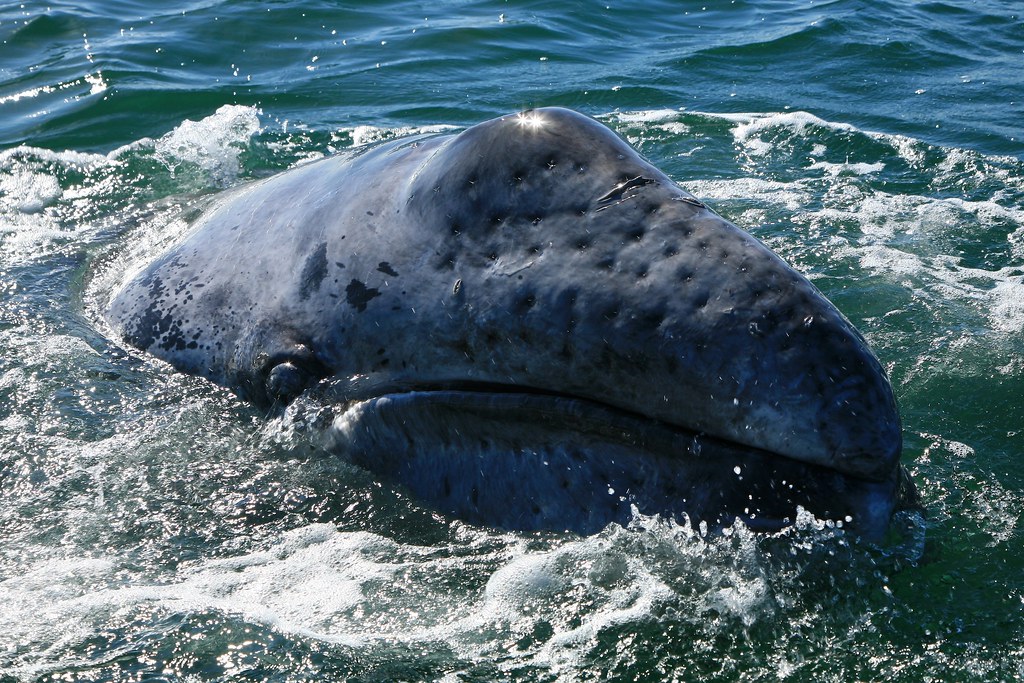
The decision to resume the practice of this tradition was a major, positive step for the Makah community. It united the Makah people; it connected Makah youth to a tradition that they had only heard of in stories and it connected elders with their memories of what it means to be Makah.7Charlotte Coté, Spirits of our Whaling Ancestors: Revitalizing Makah and Nuu-chah-nulth Traditions, (Seattle: University of Washington Press, 2010), 141-42.
…when the whaling crew was out on the hunt, a group of young girls from the Neah Bay school went to their teacher and asked if they could take ten minutes to lie still and be quiet and pray while the whale hunt was taking place, because they had been told that that was historically what young women in the community did.
Charlotte Coté talking with Makah members Micah and Theron8Charlotte Coté, Spirits of our Whaling Ancestors: Revitalizing Makah and Nuu-chah-nulth Traditions, (Seattle: University of Washington Press, 2010), 141.
Again, the tradition of whaling would be a central aspect of survival for the Makah. For, whereas whaling had originally been a practice that demonstrated the community’s determination to survive physically, it was now a practice that demonstrated its determination to maintain the right to political, cultural, and religious autonomy. The Makah cited an unemployment rate of over 50 percent, drug and alcohol abuse, and health problems as some of the issues that might be helped by reestablishing their whaling practices. The proposal stated:
reestablishing a ceremonial and subsistence hunt would be a catalyst which would allow us to instill in our young people the traditional values that have held our people together over the centuries. In addition, whale oil, meat and blubber would be a welcome addition to our diet.
Makah Indian Tribe Whaling Proposal9Makah Indian Tribe Whaling Proposal, signed by Hubert Markishtum, Makah Tribal Council chairman, received from the Makah Tribal Council Office, May 5, 1995.
Although the Makah tribe maintained that the IWC did not hold legal power over their treaty right to whale, and to some Makah – their birthright to whale, the Makah worked with the US government and the political organizations which regulate international whaling, primarily the IWC, to draft a management plan for a legal whale hunt. The primary grounds upon which the collective parties established this legal claim to hunt was not based on the Treaty of Neah Bay, but on provisions in the IWC and National Oceanic and Atmospheric Administration (NOAA) policy designed to allow an “aboriginal subsistence” quota of whales to be taken by the tribe.10Charlotte Coté, Spirits of our Whaling Ancestors: Revitalizing Makah and Nuu-chah-nulth Traditions, (Seattle: University of Washington Press, 2010), 133. The quota established for the Makah is shared with the Chukchi people of far eastern Russia. The Makah were granted 4 gray whales per year, and the Chukchi, 120. The quota was granted to the tribes in conjunction because the tribes are hunting from the same stock and because the IWC did not want to add any quotas. The IWC decided that the Makah could harvest 20 whales between 1998-2002, the designated five-year period.11Charlotte Coté, Spirits of our Whaling Ancestors: Revitalizing Makah and Nuu-chah-nulth Traditions, (Seattle: University of Washington Press, 2010), 135.
By conforming to these policy changes, the Makah willingly revised many of the very central features of the traditional hunt, including where they could hunt, how many “strikes” (defined as successful or unsuccessful strikes of whales by the hunters’ harpoons) they were allowed, the role of the captain of the whale hunt, and many others. These were all provisions established because of the decline of the grey whale population, which had nothing to do with traditional Makah hunting. However, Makah religious and spiritual customs were maintained in the purification of the whalers, canoe, and other tools. Prayers, training, and rituals all took place around the whale hunt, with great emphasis on the spiritual preparation of the whalers.12Charlotte Coté, Spirits of our Whaling Ancestors: Revitalizing Makah and Nuu-chah-nulth Traditions, (Seattle: University of Washington Press, 2010), 137-38.
Despite the lengthy process to get to the whale hunt, the Makah remained in high spirits about the revival of this tradition.
I can tell you that all of the Makah whalers are deeply stirred by the prospect of whaling. We are undergoing a process of mental and physical toughening now. I feel the cultural connection of whaling in my blood. I feel it is honoring my blood to go whaling. We are committed to this because it [is] our connection to our Tribal culture and because it is a treaty right-not because we see the prospect of money…We are willing to risk our lives…The only reward we will receive will be the spiritual satisfaction of hunting and dispatching the whale and bringing it back to our people to be distributed as food and exercising our treaty right.
Makah Whaling Commission (MWC) president, Keith Johnson13Charlotte Coté, Spirits of our Whaling Ancestors: Revitalizing Makah and Nuu-chah-nulth Traditions, (Seattle: University of Washington Press, 2010), 136.
In 1999, after receiving approval from the United States government and the IWC, the Makah had its first whale hunt in decades.
Since the beginning of the 1999 hunt, opposition to the Makah tradition has been led by animal rights groups like the the Sea Shepard, the Humane Society of the United States, the Cetacean Society International and the West Coast Anti-Whaling Society. Main contentions include the fact that the Makah had not whaled for seventy years prior to 1999, that the Makah do not require whale meat in order to survive, and various concerns over the intelligence and value of whale life. Additional complaints arose over non-Native ideas of authenticity and tradition as static rather than something that can evolve and change, in regards to Native Americans and the Makah adapting their whale hunt to fit the times and IWC guidelines. Generally speaking, none of the opposition groups express understanding of the culturally central role whaling has in the Makah community or even attempt to see the issue through the lens of religious freedom.15Charlotte Coté, “Challenges to Our Right to Whale,” Spirits of our Whaling Ancestors: Revitalizing Makah and Nuu-chah-nulth Traditions, (Seattle: University of Washington Press, 2010), 150-165.
The limited perspective of these groups is not one adopted by more major environmental organizations like Sierra Club and the Wilderness Society, neither of which has opposed the Makah whale hunt.16Charlotte Coté, “Challenges to Our Right to Whale,” Spirits of our Whaling Ancestors: Revitalizing Makah and Nuu-chah-nulth Traditions, (Seattle: University of Washington Press, 2010), 150-165.
Legal Proceedings Interfere with Whaling
In July 2004, the 9th District Court of Appeals upheld the Makah treaty rights to take whales. However, the court ruled with plaintiffs (organizations like the Humane Society, the Cetacean Society, and the West-Coast Anti-Whaling society) by agreeing that the Environmental Assessment prepared by the Makah and the United States government in 1994 did not take into account some more subtle threats the Makah hunt could have on the Grey Whale population.17Will Anderson v. Donald Evans, 350 F.3d 815, No. 02-35761 (9th Cir. 2003). The ruling invalidates the original EA and creates an injunction against further Makah hunting until a new Environmental Assessment can be drafted.18West Coast NOAA Fisheries, “Makah Tribal Whale Hunt Chronology,” NOAA Fisheries, accessed July 31, 2020, https://www.fisheries.noaa.gov/west-coast/makah-tribal-whale-hunt-chronology.
The 1972 Marine Mammal Protection Act (MMPA) and its moratorium on taking marine mammals put the Makah through years of legal proceedings trying to secure a waiver for the take moratorium. From 2003 to 2006, scoping decisions, draft Environmental Impact Statement proceedings, and waiver requests dominated the Makah whaling world. During this time, the Makah did not have international approval to harvest any whales. due to the 2002 moratorium on whaling.19West Coast NOAA Fisheries, “Makah Tribal Whale Hunt Chronology,” NOAA Fisheries, accessed July 31, 2020, https://www.fisheries.noaa.gov/west-coast/makah-tribal-whale-hunt-chronology.
2007 Unsanctioned Whale Hunt
The time-consuming legal proceedings pushed some Makah members to conduct an unsanctioned whale hunt on September 8, 2007. The hunters lacked Makah tribal approval and international approval.
While the Makah tribe had not sanctioned this hunt conducted by five Makah men, everyone mourned the loss of the whale when the Coast Guard caught the line attached to the harpooned grey whale, leaving it to rot and die, unused, in the ocean. The Makah Tribal Council issued a statement condemning the hunt and wishing that the unlawful hunt not sully public perception of the Makah fight to legally whale again.21Charlotte Coté, Spirits of our Whaling Ancestors: Revitalizing Makah and Nuu-chah-nulth Traditions, (Seattle: University of Washington Press, 2010), 183-84. This hunt did push the struggle back into the public spotlight, attracting statements of condemnation and support from various places.22Charlotte Coté, Spirits of our Whaling Ancestors: Revitalizing Makah and Nuu-chah-nulth Traditions, (Seattle: University of Washington Press, 2010), 185-86.
Unfortunately for the Makah tribe, the 2007 hunt did not spur the relevant groups into action over another whaling allowance. The Makah have been caught up in red tape since 2002.
