
The Bureau of Land Management (BLM) manages approximately 79% percent of the surface land in the Nine Mile Canyon area, and 90% of the mineral estate. Most of this property is leased to private entities, and in 2004, the oil and natural gas exploration and production company, HighPoint Resources, known as the Bill Barrett Corporation (BBC) at the time, owned the majority of these private leases. In 2004, the BBC estimated that there were about 66 billion cubic feet of gas under the Canyon, which could translate to 410 million dollars, 10 million of which would be directed to Carbon County.
While drilling for natural gas provides an opportunity for economic gain, it also poses a threat to the sacred rock art and structures. The equipment involved in the drilling process emits magnesium chloride to suppress dust, which ultimately erodes the rock art and poses potential environmental threats for the surrounding area. These threats address the existing rock art sites, but there is also concern that the intrusion of such large machines could lead to the destruction of countless sites that have yet to be discovered.1Joe Bauman, “BLM studying another project near Nine Mile Canyon,” Desert News online, May 7, 2004, https://www.deseret.com/2004/5/7/19827472/blm-studying-another-project-near-nine-mile-canyon.
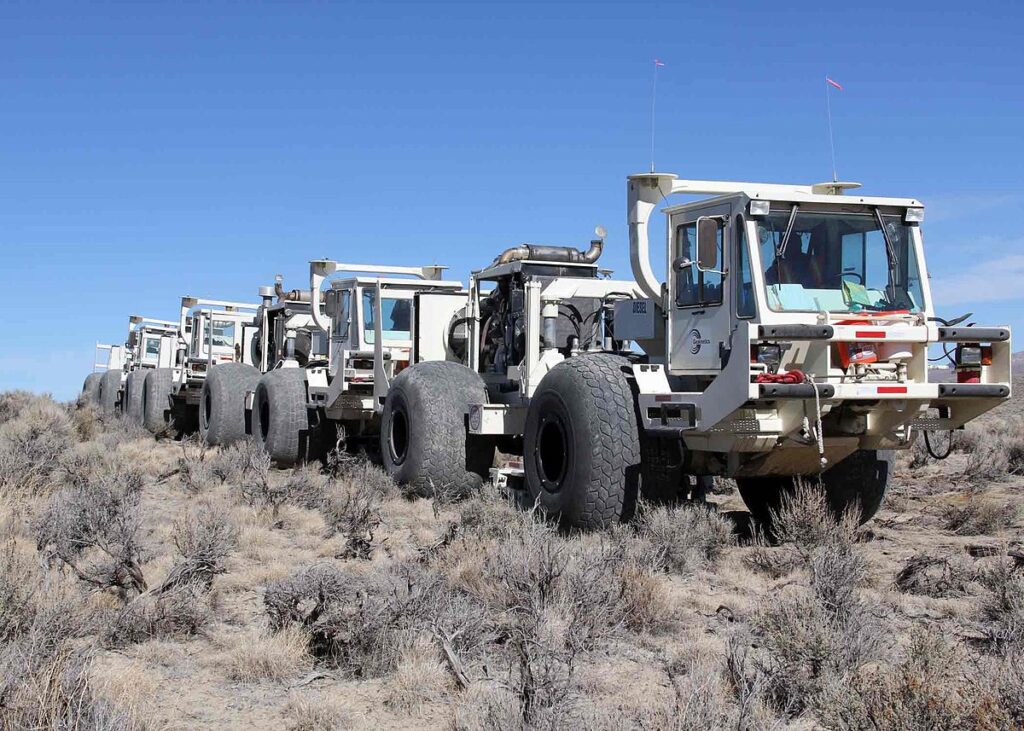
In 2004, a number of grassroots organizations sued the Department of the Interior arguing that the BLM and the BBC had ignored thousands of additional sites in their authorization of drilling in the Canyon. In July 2004, their suit failed when the court deemed that the plaintiffs’ argument did not seem to consider all of the BBC’s provisions for protecting the land, and thus did not establish an effective claim that the corporation had, in fact, violated the terms of the protective legislation. This case is just one of the many conflicts that have been brought to court in the past 16 years involving the BLM and the Nine Mile Canyon. In 2005, an 800-well natural gas development project was authorized by the BLM, despite the fact that it would substantially increase traffic and industrialization in the Canyon. In 2008, a draft of an Environmental Impact Statement (EIS) was released, angering thousands in favor of preserving Nine Mile Canyon. The BLM, however, dismissed the concerns in the EIS as “indirect”, even though it directly violated the Clean Air Act and acknowledged the damaging effects of magnesium chloride.2Mitch Tobin, The Writing on the Wall: How environmentalists and an energy company found common ground in Carbon County, Utah, California Environmental Associates, September 2011, https://www.packard.org/wp-content/uploads/2013/08/The-Writing-on-the-Wall.pdf. Referencing this EIS in an article for High Country News, BLM archaeologist, Blaine Miller, says, “It (was) the worst document I have seen in my 30 years working in the BLM.”3Jodi Peterson, “Kicking and screaming, the BLM makes a deal,” High Country News online, January 19, 2010, https://www.hcn.org/wotr/kicking-and-screaming-the-blm-makes-a-deal.
A recent case concerning the BLM and Nine Mile Canyon originated in a 2016 complaint filed by two nonprofits, WildEarth Guardians and Physicians for Social Responsibility. They urged the federal district court to halt authorizations set forth by the BLM until it was determined if the BLM was violating the National Environmental Policy Act (NEPA).
